Wednesday, April 15, 2009

Medieval Times Come To America

chartes.jpg

By Restless [Originally on goofyblog 4.25.08]

“The treatment of crime and criminals is one of the most unfailing tests of the civilization of any country.” - Winston Churchill

The United States currently incarcerates 738 people per 100,000 of population. Europe’s average is 200 (The United Kingdom is 145). Only Russia comes close at 603 per 100,000.

The U.S. is the only Democracy that indefinitely disenfranchises non-incarcerated felons, a practice prohibited by the international covenant of civil and political rights to which America is a signatory.

But who cares about these criminals and their namby-pamby “rights?”

Answer: You do.

Studies show that 2/3rds of ex-convicts vote Democratic. 5.4 Million Were disenfranchised in 2000 and 2004. Do the math – we should have had a different President all these long years.

Furthermore, allowing those who’ve served their time to vote would have prevented at least 7 key Republicans (John Warner, Connie Mack, Mel Martinez, etc.) from staying in, or getting elected to office.

The United States is also the first country to re-instate the practice of civil death or “Dead in Law” once popular in Europe about 500 years ago. It is the idea that a person can never repay their debt to society; after they do their penitence (in a penitentiary) they must run a gauntlet of years of parole or probation.

Then, the death part begins: Invasive background checks ensure unemployment or under-employment. Having a criminal record can keep you from getting an apartment, a government loan, even a driver’s license in some states.

The vaunted dip of unemployment in the US during the 90’s? Over 2 million prisoners and 600,000 more awaiting trial went unaccounted for, and still remain excluded. Meanwhile, 60% of black men have done time by the time they reach their mid 30’s.

True, the crime rate dipped in the 90’s, but was it the prosperous times, or was it the draconian sentences being meted out daily throughout the land? As economic times worsen, the crime rate is rising, putting the lie to this cruel practice that harms families and relatives of the Ex-Convict, and society in general.

What’s up with this? A Society turns on its own people. Creationism taught in schools, Laissez-faire capitalism is king, a country moving backwards.

brownback.jpg

“We don’t want to build more prisons; we don’t want to lock people up.” - Sen. Sam Brownback, Conservative Republican, former Presidential Candidate, after spending a night in a cell at Angola prison in Louisiana.

Dateline California –

In a move to ease chronic overcrowding, California approved the largest single prison construction program in the nation’s history. The plan will cost $8.3 billion and add 53,000 prison beds.

Based on current spending trends, California’s prison budget will over take spending on the states universities in 5 years. But California has all but guaranteed that prisons will eat up an increasingly large share of the taxpayer’s money because of chronic failures in a system that the state is now planning to expand.

Film Review: No Country For Old Men

No Country

By Restless [Originally on goofyblog 3.8.08]

In December I watched the new Coen Brothers film, No Country For Old Men, which has gone on to win the Academy award for Best Picture. It is a tragedy, a work of unremitting violence.

As I left the multiplex, I was moved by what I had seen, but I wasn't sure why. I thought: What are these guys saying here?

I mean, the Coens, the actors (Josh Brolin, Javier Bardim), all the artists who put this together, who made this considerable effort to construct something far more substantial than the usual meaningless mish mashes of action and mayhem like others (Tarintino’s Kill Bill 1 & 2, Rodriguez’s Sin City and Scorsese’s The Departed being the most notable examples) have done recently.

The best art reflects society back on itself, revealing the underlying reality by peeling away the white noise, the static (American idol, anything Britney/Lindsey/Paris, “reality” shows, Fox News, happy “news”) that clogs understanding.

So what reality was revealed by this film? For help, I consulted Aristotle’s Poetics, the 2000-year-old tome still considered the Bible of dramatic construction.

Aristotle

The film opens in the late 70’s with what passes now-a-days for a Greek chorus in the guise of Tommy Lee Jones' aging Texas country sheriff, which as Aristotle says serves to comment on and reinforce the central idea of the work: things ain't what they used to be. Or, to be more clear, decent people can’t stand up to or stop the ruthless, sociopathic evil unleashed by the unwinnable “War on Drugs” initiated by Nixon, who was then reeling from his failures in the Vietnam War.

This idea is reiterated throughout by Tommy in voice over and on camera as well as by other secondary characters--another type of modern Greek chorus (for true Greek choruses in modern film, see Jonathon Richman's guitarist-in-the-tree in “There’s Something About Mary” or the full-on Greek chorus used by Woody Allen in "Mighty Aphrodite").

anton.jpg

We catch first sight of this ruthless evil just after Tommy Lee’s first soliloquy in what Aristotle calls a Parode, a "parody" of the action to come, a preview, a warm-up that sets up the action in the film with the thunderously violent escape from custody of the film's villain, Anton Chigurh.

From there the film moves directly into what Aristotle calls the “Complication,” – Lewelyn Moss, a Vietnam vet out hunting antelope on his day off, comes across the violent remains of a drug shoot-out with one-half of a survivor. He recovers a satchel full of money and makes it back to his trailer-park wife with no one the wiser and his fortune seems assured.

But, Aristotle teaches there would be no drama at all without a reversal of fortune. He writes in Poetics that this reversal must come from an error in judgment, not from depravity. And finally, said error must instill pity and/or fear in the audience (not disgust and/or revulsion).

Thus, when Josh Brolin's Llewelyn decides that the right thing to do is to take the sole survivor the water he so desperately had requested, it sets up the roller coaster of action of the rest of the film. Aristotle calls this the "denouement,” our hero’s tragic reversal of fortune. But, this is just the first of several misjudgments Llewelyn makes, always however stemming from his basic decency and goodness.

From then on, every scene in the movie hammers home the single idea: Decent men and women don’t stand a chance against amoral evil. They are either destroyed by it, or corrupted by it. There is no escape.

But, Aristotle writes that the denouement in a story must build up a well of pity and fear in the audience that will finally lead up to catharsis, a release of the built up pity or fear.

In this film's case, as in the only other masterpiece of the first decade of the 21st century, David Cronenberg’s “A History of Violence,” catharsis comes at the end when we finally realize that the urge to decency, to goodness, can never be completely exterminated by corruption or evil.

This makes for mature, modern entertainment!

No Country For Old Men is the place our country has come to inhabit.

Check it out!

4 Fantastic Films - III

Four Films

By Restless [Originally on goofyblog 11.30.07]


1. The Century of the Self (2002) Pt. 3

At the end of the 50s, Anna Freud’s psychoanalytic methods were being challenged by those alienated by businesses’ use of them to sell products and also by a growing awareness of several major failures: Dr. Cameron’s experimental treatments using drugs and shock had failed, and the family on which Anna had based her treatment model had suffered casualties. Then there was Marilyn Monroe.

The 60s: The Tower Burns
The FreudiansMarilyn Monroe

The abuses of Dr. Cameron and the sorry state of Anna’s failed guinea pigs were not well-known, but Marilyn was famous worldwide. In 1960, she had turned to Anna Freud’s Los Angeles associate, Dr. Greenson, for treatment. Employing Anna’s techniques, he tried teaching Marilyn normality and seeing her daily, even hiring an assistant to monitor her at home. His treatment included drug therapy, and Marilyn became dependent on barbiturates.

When she killed herself in 1962, many in and outside the psychoanalytic world were shocked. Challengers and critics rushed the gate.

The Challengers

In the late 50s, a small group of renegade therapists in New York City had begun practicing new therapies, influenced by the teachings of Wilhelm Reich – himself an original disciple of Sigmund Freud. Reich had formed a concept of human behavior radically different than Sigmund & Anna’s: repression of essential human nature was the cause of all individual and social ills.

According to Reich, sexual energy is the primal force animating every person, thus all neuroses were caused by failure to orgasm. Free a patient’s sexuality and he would flourish. Static societies needed to be changed to be made more livable, human, sexual.

The Critics

hidden-persuaders.jpgIn 1957, Vance Packard published The Hidden Persuaders, a book that called attention to businesses’ use of Freudian theory to create Pavlovian mass consumers. It had been a best seller, the book title itself becoming a common figure of speech.

Radical philosopher, Herbert Marcuse, had begun criticizing the empty prosperity that had been created by the broad conformance to a static social model. The idea people needed to be controlled was wrong, said Marcuse, agreeing with Reich: the individual should not conform. The unhealthy forces Anna Freud had seen in people were caused by a repressive society.

Ghettos raging; student, hippies protesting, playing; Babylon burning

Students demonstrateMarcusian theory was used by the new Student Left to justify protests that attacked corporations and demonstrations opposing the Vietnam War. The mindless conformity of the 50s had led inevitably to a mindless war in Southeast Asia. American business and US government interests had become one with neither the advice nor consent of the people.

The students saw themselves as autonomous citizens in a democracy, able to make their own decisions, and rejected any secret or overt manipulation by business and government propagandists, still using tired Freudian techniques. Rebelling against consumerism, they experimented with non-conformist, anti-corporate ideas: communes; sexual freedom; long hair; funky attire; civil rights; women’s liberation; gay lib.

Bobby KennedyWhen the strong leaders, those who had radiated hope and pushed for non-violent change, were assassinated, and the US continued pursuing the war, even in the face of massive student opposition, some of the Left decided they needed to go farther.

The Weathermen group began a series of bomb attacks against the corporate structure. The police and FBI struck back hard. At the 1968 Democratic Convention police were set upon protesters, clubbing them at will. After 4 students were killed by the National Guard at Kent State, the Left began falling apart.

Out-gunned, they started turning inward, using Reich’s theories again: go inside, change oneself, change society from within.

The 70s — The Me Generation? – Reichians triumph

Esalen InstituteEsalen, initially a small West Coast retreat near Big Sur became the locus of this move inward. Fritz Perls – an Esalen therapist trained by Reich – created gestalt therapy as a new way for individuals to see and express their hidden inner feelings, and in so doing, free themselves of all social conditioning.

Experiments in social change via personal liberation were attempted, first with black and white radicals, then with a convent. As the nuns found liberation, they released their repressed sexuality. In the end, over half renounced their vows, some became radical lesbians — the convent closed its doors.

Thousands flocked to Esalen and other centers that were founded to emulate it. Then philosopher/entrepreneur Werner Erhard developed a method for mass producing self-expressive individuals. Calling it est – erhard systems training – he did his trainings with large groups in grueling all-day sessions, stripping off participants’ layers of social conditioning, going down to their nothingness. Once there, individuals were free to re-create themselves from that nothingness. They could be anything they wished to be.

Werner of estErhard taught that it was one’s highest duty to become a fully actuated individual. One of his aphorisms was “Participation is health.” These newly actuated individuals would change society by sheer numbers.

Est became hugely successful and was replicated all over America, the UK and other parts of the world.

As this internal “revolution” took hold, Business wondered: how could they reach these new individuals? Their old focus group model was of no use — fewer people were interested in participating. Moreover, existing methods of mass production wouldn’t work with this new urge for individual expression by consumers.

A leading market researcher, Daniel Yankelovich, was hired. Using surveys Yankelovich discovered a surprising truth about the Human Liberation Movement. Expressing oneself had become the most important thing, superseding all else.

The urge to change society had become irrelevant. What now emerged was the idea that people could be happy simply within themselves.

By 1980, a vast majority of the population had become preoccupied with the self. Then Ronald Reagan stepped onto the stage, and using Reichian theory, became the first politician to talk to these new beings and in so doing he defined the way to political victory for the next 27 years . . . and counting.

Ronald Reagan

[more tomorrow]

Now a Word. . .

By Restless [Originally on goofyblog 11.27.07]

Confused mouseMy abject apologies. Right in the middle of writing and publishing the series on the 4 Fantastic Films, my laptop punked out.

My tech skills are pretty rusty, and it was the day after Thanksgiving. I immediately thought: has to be the hard drive. Quick get on craigslist, 2 hours later a meeting at a Starbucks and problem solved? Not quite.

When I bought this Dell Inspiron 2 years ago, I added a 1-year on-site warranty. That was good because it failed immediately. Error messages saying the “module” wouldn’t seat onto the motherboard – which module? The only modules I had was the CD-R or the hard drive, but Dell Support instructed their sub-contractors to replace the motherboard instead – and they had to do it 3 different times.

So, twice, in a Starbucks, and once, in an empty trash-strewn 2-room office about a block from Ground Zero, I watched and learned. Now, it was my turn.

Layer by layer I pulled the Inspiron apart – first the hard drive, then the DVD-R (a free upgrade for all my “trouble,” evidently the problem in the first place). Then, keyboard, screen, modem.

Finally, I got down to the fan housing and pulled it away from the copper heat sink that lead to the covering over the cpu.

A thick layer of black dirt and hairs was clogging the heat sink! I’d wondered why the fan was working so extra hard at the end of the summer. The chip was fried.CPU

Oh well. The guy who’d sold me the hard drive had thrown in an external drive casing, and kind relatives had donated an old desktop. No data lost . . . just a dead laptop.

A quick search on eBay and I’d bid and won a new chip from a company in Georgia – I’ll be portable again in another week.

The desktop was wrecked – old SIMM, funky hard drives (WARNING: IBM hard drives are defective, that’s why they went out of the hard drive biz in 2002). All I had to do now was completely rebuild the operating system and install all the programs I use daily (Office, Photoshop, etc.).

4 false starts later, I’m up and running. Then a jillion upgrades, service packs and patches more, and finally, I’m done.

The documentaries are worth seeing and definitely worth writing about. I’ll start up again tomorrow. Stay tuned for the 60s and the age of Reich (below).

Wilhelm Reich

4 Fantastic Films - II


By Restless [Originally on goofyblog 11.21.07]

Four Films Part 21. The Century of the Self (2002) – Pt. 2By Restless

In 1929, the stock market crashed and people simply stopped buying anything they didn’t need. Sigmund Freud’s nephew, Edward Bernays, saw the power and influence he had amassed during the 20s whither as business and government lost control of the people, now rioting against the corporations they blamed for the downturn. As the depression in America deepened, it helped to worsen the economic & social situation in Europe.

The 30s: Freud, Hitler & Roosevelt

Freud in Vienna became convinced humans were full of dangerous impulses and should never be allowed to truly express themselves. Democracy was illogical. He wrote Civilization & Its Discontents wherein he warned that people could easily be manipulated to love their leaders, while being turned against any outsiders.

Adolph Hitler in 1933His writings influenced Adolf Hitler and the Nazis, who came to power promoting the concept democracy was too dangerous, chaotic, leading only to unemployment and disaster. Societies must be planned. In 1933, his government started dismantling democracy, first controlling businesses, then more and more aspects of German life.

Elected in 1932, Roosevelt had similar ideas about business but completely different ideas about people and democracy. Yes, business must be regulated and reigned in. People on the other hand were rational and could be relied upon to make wise decisions when well-informed. The Founders concept of democracy was to be preserved and enhanced under his watch.

He worked with Joseph Gallup, who devised the first-ever polls of the people to find out what they wanted and what they were feeling. Armed with their opinions Roosevelt felt it was government’s role to enact the people’s will.

Hitler’s Minister of Enlightenment and Propaganda, Joseph Goebbels, agreed with Roosevelt in regard to business: corporations must be controlled by government so that people had work and could support themselves. But when the Nazis took Austria in 1938, they employed Freud’s warning as their game plan, unleashing the deep frustration of the unemployed masses on the outsiders, the Jews. Seeing this, Sigmund fled to Britain with daughter Anna, whom he had analyzed and then trained in his psychoanalytic techniques.

Roosevelt in 1932When Roosevelt was re-elected in a landslide in 1936 by promising even more controls on business, corporate leaders, fearing a dictatorship, decided they had to fight back. Calling on Edward Bernays and others, they began to produce propaganda: films extolling business as the true and only engine of prosperity, news articles that were nothing more than publicity for business giving the impression that they were the movers for good not sole profit in society and thus their motives should not be controlled or questioned.

1939 New York Worlds FairThe ability to insinuate this type of pr into main-stream journalism was clever and has been used in many ways since, but Bernays’ piece de resistance was in the creation of the New York Worlds Fair in 1939. Financed by corporations such as General Electric, the Fair was a truly impressive work effectively propagating the message that only business could bring consumers what they needed offering a vision of people, not as active citizens, but as passive consumers.

Their rational thoughts were not in charge any longer, instead only their desires were, which can be then controlled by business elites.

As WWII began, Sigmund Freud died of cancer and Anna became head of the Psychoanalytic movement. A severe, virginal woman, first analyzed by her father once he discovered she was masturbating, her goal was to push her father’s theories as the only true way. She had a messianic fervor and could never admit any mistake or acknowledge any other possible path.

The 40s: the Triumph of Conformity

Anna FreudJust before the war had begun, a wealthy New York mother of 4 fled her divorce, bringing her children to Anna for treatment. She began an experimental therapy, strictly controlling the environment of her young patients, believing the children could be taught to conform to family and social norms, and then their egos would be strengthened. In this way they would be able to control the dangerous forces within themselves. By adapting to the society around them they would be happy. Society and thus democracy would be secure.

But Anna never questioned if the society itself was causing the irrational behavior in her patients.

Shell shocked US Marine WWII After America’s entry into WWII in 1942, the military became alarmed at the large number of soldiers suffering what is now called post-traumatic stress disorder – see my article of February 13th. A Freudian psychoanalyst, Karl Menninger, was given authority to do a massive study on American soldiers and civilians.

Using Central European refugee psychoanalysts – due to a shortage of trained analysts in the US – they probed hundreds of Americans. They concluded Freud had been right: just under the surface, human beings were driven by primitive irrational forces – they saw a vision of human nature as incredibly destructive. If allowed to go untreated these forces could infect society, they were a threat to democracy.

They came to believe what had happened in Germany and earlier in Russia during the revolution was the result of uncontrolled drives. The Menninger study convinced political leaders who were reeling from the shocking discoveries of the atrocities committed during the War: something must be done.

In 1946, President Truman signed the Mental Health Act of 1946, which set up hundreds of Guidance Centers in the US to deal with these mental health “problems” revealed in Americans.

The experimental techniques Anna had used on the New York family were used by the Menninger brothers to re-shape the psyches of their patients, not just children as Anna had, but adults also.

The goal: to teach people to control themselves and conform by using the new “science” of psychoanalysis thus making for a better society . The Menninger clinic was founded and psychoanalytic workers were trained to use these methods at Centers situated in hundreds of towns across the nation.

The 50s: the Strategy of Desire

50s Ad for Betty Crocker Cake MixesBusiness also was interested in the secret self of the American consumer. Betty Crocker Foods was marketing a new product — instant cake mixes — but it wasn’t selling well. They employed, Ernest Dichter, one of Anna’s peers and Dichter devised the first focus groups, finding there was unconscious guilt about how easy the powdered product was to use.

Using Bernays’ old-school techniques of manipulation, Betty Crocker reduced guilt by changing the instructions on the box, telling consumers they must add a totally unnecessary egg to the mix. Guilt assuaged, consumers bought Betty Croker by the millions.

Dichter’s success led business to rush to employ psychoanalysts using the new concept of focus groups to probe American’s underlying secret traits, the sexual and social secrets too embarrassing or unconscious for people to verbalize. Products now were being marketed as having a therapeutic value: using products made you more secure, and thus more successful – to your benefit and for the betterment of society.

Meanwhile, when Soviet Russia tested its first nuclear bomb, politicians turned to Edward Bernays to quell public fear. But Bernays had always felt the only way to deal with the public was by manipulating their subconscious desires and fears. At heart, he believed people were stupid and they could not be told the actual reasons they had to be fooled and tricked. He successfully argued that the public’s fears should be amplified and then used as a tool in the Cold War.

Now, American affairs began to take a turn. Forces in President Eisenhower’s Administration became convinced that American businesses must be protected at all costs, seeing business and democracy as one and the same. In 1950, a mildly socialist president had been elected in the miniscule country of Guatemala.

Vice President Richard NixonUp until his election, the giant US corporation United Fruit owned much of the land and had been controlling that nation’s government while running their plantations there. President Arbenz was promising a land reform and the end to the domination of this American business. United Fruit turned to Bernays who ran a propaganda campaign using falsehoods and dirty tricks to imply Arbenz was a communist puppet of Soviet Russia, while CIA operatives trained an army, hand-picked a new leader, then sent in bomber planes to paralyze the country.

After Arbenz was toppled, Richard Nixon, Eisenhower’s VP, flew to Guatemala City and, in front of stacks of Communist booklets planted in the Presidential palace by Bernays, gave a speech supporting the “overthrow of the communists by the people.”

The Corrosion of Conformity

50s Cadillac Tail FinBy the mid-50s, Freud’s ideas had penetrated American business, political, entertainment and journalistic spheres. Psychoanalysts were rich and influential, sought after. Once again as in the 20s, the masses could be controlled by feeding their underlying desires, but now it was the future of a stable democracy that was at stake. People needed to conform to societal mores for the good of the whole. Their animal natures needed to be subjugated.

The foundation of our democracy is that change can and should be brought about by an informed and free citizenry, but Freud had challenged this, seeing people as incapable of deciding anything rationally. His theory was authoritarian: society would remain static unchangeable, instead the individual must adapt to it. The idea that an elite could control the masses via conditioning for their own good had triumphed. Aside from a few beatniks there was not much challenge to this brave new world.

Venice West Cafe 1950sWith the success of the Guatemala coup, the CIA began to take these ideas much further. Hearing that the Soviets were possibly able to program people in any way they wished, they set out to find if they could do it, too. They poured millions into universities across the country in an effort to determine if mind control could be done.

One of the beneficiaries of the CIA’s funding, Dr. Cameron, became impatient with psychotherapy: it was taking just too long. He began experimenting with psychedelic drugs and electroshock, putting tapes under patient’s pillows attempting to change them subliminally to quickly alter human behavior. Instead, he reduced his patients to a vegetative state. In the end, all his experiments ended in complete failure.

And though Anna Freud had triumphed, her methods were not holding up. The family upon which she had formulated her theories weren’t responding correctly. Now in mid adulthood, they had become alcoholics, suffered divorces, were having nervous breakdowns. One had committed suicide.

Something was really out of whack.

[More Friday – Happy Thanksgiving]

4 Fantastic Films

By Restless [Originally on goofyblog 11.20.07]

Fourmonths ago, the best aggregator of full-length video, jonhs.net – see my article of March 5th — changed urls, now moviesfoundonline.com. Youtube and other sites are great for short vidclips; this site is the best repository for the longer stuff.

Want standup — Pablo Francisco, Dane Cook, Carlos Mencia, Bill Hicks, Dave Chappell, Andy Kaufman, George Carlin? Click the Entertainment link.

What about movies? There’s “It’s a Wonderful Life,” “The Lost World,” “Joan the Woman.”

New, old; more are added weekly.

Docs on Iraq or 9-11? The site is the most comprehensive I’ve seen.

But, what’s best about this fantastic site are the Documentaries links. In the past 4 months, I’ve watched 4 remarkable works, three of which can be found there, that have fundamentally altered my understanding of the how we got to where we are today. That knowledge is power is true; the power to see where we can and must go now.

This is the first in a series of articles on these films. Don’t miss them!

1. The Century of the Self (2002)

Czar Alexander III, the last AristocratPerhaps the best documentary I’ve ever seen. A history of the 20th century — in just 4 hours.

The century’s beginning marked also the beginning of the triumph of democracy. In its first 2 decades, most monarchies in the West were destroyed or saw their powers reduced to impotent ornamentation. By mid-century, most Asian ones had disappeared as well.

In 1900, most lived in rural communities under an aristocracy. By 2000, most lived in urban communities under some form of democracy.

But, as they say: the more things change, the more things remain the same. The dream of representative democracy, government of the people, by the people still eludes us.

This documentary shows clearly how elites still rule — not by aristocratic custom, but by ideas first developed at the turn of the century in Vienna by the father of psychoanalysis. It is about the most influential family of the 20th century.

Freud – WWI — the end of the aristocracy — birth of mass culture

Sigmund Freud

After unsuccessfully promoting cocaine as a new wonder drug, Sigmund Freud invented new techniques for analyzing the individual. From his analyses, Freud theorized there were powerful, hidden primitive sexual and aggressive forces deep in humans, forces that if not controlled would lead societies and human beings into chaos and destruction. It was only decades later, that many of his conclusive theories were proved misguided at best or false at worse, such as the concept that his women patients who complained of incest were hysterical, imagining things or that all sexual urges or feelings were dangerous and needed to be repressed.

When WWI broke out, followed by the Russian Revolution, Freud felt he was on the right track — his new theories about human nature were proved.

Edward BernaysAt the time, his nephew Edward Bernays was a US press agent for opera singer Enrico Caruso, but when America entered the War, President Wilson appointed Bernays to promote the necessity of our entry, which was counter to the campaign promises he had made in his recent re-election. Wilson declared he was entering the war not to restore the empires, but to spread democracy throughout Europe, and Bernays proved extremely adept at spreading this concept both in the US and Europe.

When the War ended, he was asked to accompany Wilson to Paris, where he realized just how successful he had actually been as masses of people jubilantly greeted Wilson as a Savior. Bernays decided that what he could do in times of war, he might be able to in times of peace.

But how? He turned to the writings of his Uncle Sigmund. From Paris, he had sent his Uncle a box of Havana cigars and in return had received a copy of Freud’s Theory of Psychoanalysis. Freud’s depiction of the hidden forces in humans fascinated Bernays. Could he make money from people’s irrational hidden desires? He returned to New York and opened the first public relations firm.

Freud’s Nephew & the Roaring 20s

Power Smoker

Bernays first effort was to see if he could get women to smoke, which was a strong societal taboo at the time. He called in the American psychoanalyst, A. A. Brill. Using Freud’s theory of penis envy, Brill told Bernays that women would feel more powerful if they smoked for then they would have their own penises, challenging men. Bernays devised a stunt that changed society and became known the world over.

Persuading a group of wealthy debutantes to do a “group smoke” at New York’s Easter Day parade, he touted their rebellious act as lighting “torches of freedom.” He propagated the idea that when women smoked they became more powerful, more independent, more free.

Corporations suddenly became extremely interested. Up until then, goods and products were promoted solely for their practical value. Because of the great successes of assembly-line mass production, businessmen were now worried they would soon saturate the marketplace and then see their profits decline.

If people could be persuaded to believe that smoking cigarettes would make them more free and powerful, they might be made to believe buying other products were good for them regardless of their actual need.

Bernays showed business how they could make people want things they didn’t need, by linking their desires to mass produced items. Out of this, would come a new political idea about how to control the masses. By satisfying people’s inner selfish desires, one made

Jazz Babythem happy and thus docile, which was the start of the all-consuming self, which has come to dominate our world today.

Bernays used his uncle’s theories as the foundation for the creation of the mass consumer. He used movie stars & sports figures in the first testimonials and began the first product placements in movies, cleverly promoting cars as symbols of male power and energy.

Then, starting with Coolidge, Bernays was called upon to promote political figures. Public relations had entered into politics

By 1927, the US had become not a nation of citizens but a nation of consumers. Bernays propagated the idea consumers should also participate in the stock market, buying shares on credit.

Freud Darkens — Infects Politics — Intellectuals Embellish

Meanwhile in Vienna, by the mid 20s Uncle Sigmund was nearly broke in a war-ravaged and depressed Europe and appealed to his nephew for help. Bernays responded by getting Freud published for the first time in the US, becoming his agent, getting him accepted there, fundamentally affecting journalists and writers – the American intelligentsia.

By then Freud’s ideas on human nature had become more pessimistic. In the aftermath of the war, he saw groups of people as animals driven irrationally by deep forces of sadism. The guiding principle of democracy – citizens were rational and could be trusted to make decisions based on the facts – was wrong.

The influential American journalist, Walter Lippman, theorized that if this was so, then it was necessary to rethink democracy, which was now too dangerous; what was called for instead was a new elite that could manage the “bewildered herd.”

Bernays had found it easy to manipulate the masses and thought people were stupid; said so many times. He took Lippman’s theory as his own. People needed to be socially controlled, their hidden desires needed to be stimulated, then guided to the acceptable solution. Democracy could be run this way; the masses could be managed, docile, happy, through the creation of a consumerist society. When Hoover was elected in ‘28, what Bernays called “enlightened despotism” became the new model for running democracy.

By the end of the 20s, he had become one of the rich, influential elite in this new world.

Stock Market Crash 1929

Then in the fall of ’29, his success at promoting stock market speculation by the masses –shoeshine boys had stocks by then – backfired and the simple world of the docile consumer ended.

[Continued mañana]

Escape from New York

By Restless [Originally on goofyblog 11.8.07]

Escape from New YorkTwo and a half years after planes were flown into the Twin Towers, I moved to New York City. I’d been thinking about living in New York City for like 30 years, yet there had always been something daunting about it – cold, distant, big, tough. Shy and easily crowd-shocked, close to my dysfunctional family, I wasn’t ready for any of that.

Then, during the 90s, I lost all my reservations one by one. I began long-distance travelling in ’97 and by summer 2001 I had 3 trips to Europe and 1 to Chicago under my belt. So, when the buildings fell, I thought seriously of going to New York for the first time. I wanted to help out. A manager I once worked for had transferred there and I discovered his office had been on the 100th floor of WTC2. I sent him emails and he finally responded: he’d been late for work that day. For awhile I regretted not rushing to New York.

Now, I’m glad. Volunteers are now dying from whatever it was they inhaled while helping downtown after the authorities assured them it was safe.

But, the next Spring I did go, flying into La Guardia, taking the subway across the East River to Manhattan. No hotel reservations, no clue as to where to go – in New York City for 10 days. Not so daunting once you’re there. I liked it there immediately. I had my hair bleached on Astor Place. I stayed at the Chelsea, then moved to St. Marks, finally to the Gershwin. I got sore feet from walking.

Chelsea HotelNear the end of my stay, I met a friend for lunch. I picked her up at the NJ Ferry in a cab, took her down to the pier at the bottom tip of Manhattan. Afterwards, we wandered around downtown looking for a Starbucks and came upon Ground Zero. By then, advance reservations were required for the long wait to stand on the raised platform above the boarded-up block to see the hole that was once the World Trade Center. The line stretched on down the block.

On the cab ride back, we passed the site from the other side, slowed by the congestion on the highway, Battery Park and the water on our left. We could see that chunks had been ripped out of some of the buildings on the periphery, adding to the sinister effect: something evil had happened here.

In the aftermath of 9/11, authorities in New York and elsewhere began using terrorism as the catchall excuse to muzzle the people’s right to demonstrate for change, one of the engines that drove America and made us the most dynamic and admired society on Earth. In summer 2004, when the Republicans had their Convention at Madison Square Garden, protests were broken up by mass arrests to a holding area out on a remote pier. Later, all charges for most were dropped.

In this new world, bicyclists were now terrorists, too. Using this stupid excuse, the NYPD made mass arrests at one of the last-Friday-of-the-month demonstrations Critical Mass uses to bring attention to the need for more bike lanes. Biking in NYC is still very dangerous, while in other cities, Critical Mass has pushed leaders to make streets more bike-friendly.

Cops were stationed in random subways and terminals, watching for what, I was never sure. And there were what seemed like daily demonstrations of cop-car power in Times Square — caravans of 20 or more, sirens screaming, jetting down 42nd west from the Square.

This fearful reaction bled over into the business sector. I noticed bomb-sniffing dogs being used in downtown parking lots. The search for temp office work was littered by background checks, urine tests, credit checks, sometimes even fingerprint and iris scans. It was extremely rare to not have to go through some kind of security ceremony in order to enter any office building in New York.

My BadgeMost had a computer cam, coupled to a database, with a label printer. You’d get your daily badge and then have to do it all over again – everyday, for every job. Other buildings had no badge process at all meaning everyone had to wait in long lines to show ID.

Though some terrorists flew planes into buildings, apparently the new threat to our freedoms were middle-aged temp office workers – and measures were being taken.

But they would have been unsuccessful in foiling them. In many buildings, the low paid security personnel misread my ID then printed out a badge with the wrong name. In others, after a few days of regularity they’d just wave you through.

Some places were worse than others. One I particularly detested was down just off Wall Street. One of my agencies had their offices there and they were giving me free training in presentation graphics so I had to go in. In the lobby, you had to go state your name, destination, person you were visiting, show ID, then wait while they called up. Then they would print a no-pic label badge and you’d be on your way – allowed to walk 10 yards, and forced to show another guard not only your freshly made badge, but your original ID, because after all, you might have switched identities on the 10-yard walk.

Homeless sleeping midtown summer 2007Since I didn’t want to end up like the guys in the picture at right, I had to put up with this ridiculous practice. The ID above resembles one I received every single day at a place I worked this summer 3rd shift on the weekends. It was the worst. Our “office” was in Basement 2, and I needed to borrow someone’s badge to enter every door including the bathroom. When my agency said they wanted a urine sample to continue there I told them bye bye.

By then I had begun to run into fellow temps who had quit their perm or long-term temp jobs at other corps in protest over those firm’s instituting of extra, invasive, pointless security procedures (fingerprint scans for one, extensive bg checks for another).

It may be difficult to understand how this incessant security stuff, aggressive police presence feels unless you are under it. Some aren’t affected at all. Others put up with it. Did I feel safer? No. I felt more watched. The boundaries had shrunk, it was like something wild had been hunted and trapped in the name of safety.

The day before I left New York, I got gig at a new firm located in the CBS building . In the center of the block, the building had entrances on 53rd and 52nd. The security procedure at this building was the oddest of them all. On a small 4×5 clipboard was a pad of small entrance tags to be filled out. You then showed ID and were allowed to go to the elevators. No badge. Meaning one had to do this whenever you left for lunch or breaks. And since you didn’t have a badge, you had no access once you got to your assigned floor until a perm employee came out of the elevators or walked by and saw you through the glass doors.

I had to go through this in most of the buildings I worked, but usually I could flash my badge to whomever was about to let me in. Not here though, leading some to question me again as if I had somehow gotten through 5 security guards in the lobby and was now about to gain entry to floor 17, where I would finally be able to accomplish my nefarious goal: typing boring documents for bored attorneys. Only to be foiled again by Joe Mailroom Clerk, questioning me closely on my motives for standing outside the glass door by the elevators. Drat! I almost had them didn’t I?

When I finally left that day, I decided I’d walk up the east side of Central park to my place. I got off the elevator and started out towards one of the entrances and got to mid-lobby before I realized I was heading out 52nd the wrong direction. So, I did a 180 heading back through the elevator banks to 53rd, zoning out to 2Pac on the iPod.

This black security guy is running towards me, but I can’t hear what he’s saying because I have plugs not buds in. By time I get one of them out, he’s in front of me midway through the elevator area.

“You can’t do that!”

“Do what?” looking at him, surprised, irritated.

“Do you work here?”

Like why would I be coming out of the elevator if I didn’t work here? “Yes!” Emphatic. Started to dawn: he didn’t think I’d come out of an elevator – and I had no badge to show I worked there even for the day, no way to prove anything.

I turned and saw another guy running toward me from the 52nd street side. He had only seen the part where I walked back into the elevators, hadn’t seen me turn around.

“You don’t do it that way! You sign in!”

I looked at them both. “I just got off the elevator!” my kneejerk reaction to this idiocy showing through as I started on to the 53rd street door. Both of them were suddenly uncertain not wanting to believe.

“I just got off the elevator!!” and I was out the door. Thank God Almighty, free at last!

On the way up along the park, I thought about it. What if they had decided to detain me. Yeah, it could have been much worse. It was starting to feel like I was going from one what’s next to another. So, what was next?

Ben Franklin had it right when he said a people who would give up an essential liberty for temporary security deserve neither.

That night, I worked for hours on a high-res scan of a fake ID I’d bought from a hidden link on a non-descript web site 2 years before. Cash sent to a post office box at a small Illinois town had seen it come in the mail months later. But a year in my wallet had almost destroyed it: my photo was only half there and I’d thrown away the original passport shots long ago.

By dawn, I had something acceptable. And it was time to Escape from New York. To where though? Is the rest of the country as bad as this? I had to find out.

Make a Call, Kill a Bee, Redux

By Restless [Originally on goofyblog 10.30.07]

Colony Collapse DisorderEarlier this year, I wrote about the mysterious death of bees this past year. Given the name colony collapse disorder to reflect the potentially catastrophic decimation of honeybee colonies in the US and Europe, a German study pointed to waves from cell phone transmittal stations as probable cause.

Not true. The real reasons for colony collapse disorder turn out to be much more complex, going to the heart of modern factory farming:

o European honeybee (apis melliferahas long history of human management; stores honey in bulk; lives always in large colonies (30 – 100K).

o During past 10 years, China honey underpriced US, leaving only pollination services to stay in business.

o California almond crop (800,000 acres in Central Cali alone) entirely depends on honeybees; can’t get crop insurance without 2 – 5 colonies/acre. Apples & blueberries run close second (90% bee pollination); peaches (50%); oranges (30%); squash & melons all rely.

o Factory farming means monoculture in the fields — no weeds, any other plant, no other insects; heavy use of pesticides.

o Bees must be trucked into the farms to replace insects killed by the pesticides. 100% of US commercial bee colonies are used just for the California almond crop, trucked in starting in November.

o Enroute, bees are fed high fructose corn syrup and soy protein. But these aren’t whole foods for bees, so cause malnutrition. After pollinating crop, bees have nothing to eat due to monoculture.

o Bees weakened by the above become susceptible to:

· tracheal mites — jumped from other species in the 80s;

· varroa mites — which carry 25 viruses, in the 90s.

· nosema, a fungus that invades bees weakened by mites.

· foreign predators – African beetles in Florida overrun docile honeybee colonies.

· pesticides used on the crop they pollinate.

· lower protein content of pollen — due to global warming.

o This year’s pollination process required emergency changes in the law to allow Australian imports of honeybees. But Indian bees have been discovered on an Australian ship recently and the Indian bees are host to a 3rd kind of mite which would truly decimate the European honeybee should it make it to the US.

o The only beekeepers not affected are those that don’t artificially feed, use non-chemical mite control and do very little or no trucking of their colonies – equates to lower income, which very few pros can do and survive.

o Even before last year, world honeybee population had declined by 50% in 30 years.

Factory farming driven by petrochemicals doesn’t work, is headed for massive failure led by honeybee’s decline. Biodiversity is the only real answer. It’s all about pollination.

Do we want to continue to eat?

For more detail, see Gina Covina’s piece on AlterNet, from which this post liberally borrows.

One Dead in Ohio Part II

By Restless [Originally on goofyblog 10.28.07]

Midnight in a Greyhound depot underneath one of Pittsburgh’s many bridges. The harshly lit rectangle of a room was packed. Amish, black, latin, whites. One of my bus mates from New York, a short, fat guy, sat down at the table next to what passed for a café. Based in Pittsburgh at NightArkansas, he delivered school buses for a living, then took the bus back. Without prompting, he went off on George Bush, a scenario to be repeated with others over the next few days.

An hour passed and we re-boarded, with a fresh bus driver and some fresh passengers. Our Opus Dei pastor had taken the bus to Cleveland, thank the Lord. A Rob Zombie lookalike, tall, dreads, guitar strapped to his back, sat a few rows back.

We drove out from under the bridge and up through town to the freeway as our new driver did the standard spiel twisting it into a mildly funny standup routine. We were on the road to Columbus, set to arrive at 4am for an hour breakfast break. Hadn’t seen my friend Bill, who lived near there, so I’d called him as I left New York to see if he was up to a real early start to his Friday and he was game.

I tried to doze in the dark, now quiet bus. 2 hours later, we pulled over onto that area between an on ramp and the far right lane of a freeway. Our driver announced there was a problem with the bus and we’d have to wait for a replacement to be sent from Columbus, now 70 miles away. He allowed us outside for a smoke and fresh air, but told us: stay close to the bus, stay off of the on ramp.

The freeway was deserted; the on ramp looked to be the outlet for a small country road. I went out twice, calling my friend to tell him of our delay, then walking up the on ramp away from the bus to take a piss. The night was mild, breezeless and quiet. I took my seat on the bus, sitting a few rows behind the driver.

I could hear something coming down the ramp. Then desperate shouts watch out! watch out!! And thwack!!! — a sickening sound – a car swerved into view stopping in my line of sight on the island in front of the bus. A guy in a white T-shirt got out wringing his hands and walked back. He’d plowed into a young Jewish man who’d been walking with an Asian man on the ramp talking their backs turned. When they finally saw the approaching car they tried to dodge it – just as the driver tried did the same.

The passengers across the aisle went into a running narrative. A young girl ran back onto the bus and down the aisle crying. I couldn’t bring myself to look. I thought it might have been Rob Zombie, who was out there and whom I’d spoken to a few minutes before.

First a fire truck, then 2 state trooper cars, finally an ambulance came. I could see the driver of the car being put into the back of one of the trooper cars. He was weeping. He passed a breathalyzer test and was eventually released to drive away even before our replacement bus arrived. The medical people were helping the Asian passenger sit up on the gurney, then carried him into the ambulance.

The young man died later that night. He was 26, on his way to visit a grandmother in St. Louis.

An hour later, we got a new bus and driver, drove to a rest stop, waited another hour for a mechanic to fill the old bus with coolant. When our original driver limped the old bus into our stop, he sat in front on the right. He was inconsolable. In sue-happy America, he was about to have major problems.

We got to Columbus 3 hours late and were met by insurance investigators who kept us from leaving for another 2 hours.

Why were those guys walking in the road like that? Why didn’t the bus driver go to the rest stop? Life is so fragile, it can end so easily.

I’d been watching many documentaries on the wars of the past 30 years. Millions have died just because of a concept, a political dogma or religious belief. During Pol Pot’s reign of terror just wearing glasses was a death sentence. Our passenger had died young, there was no reason, no meaning to it.

Get your affairs in order. Be aware of the gift of life.Greyhound Bus Station America

My friend met me at the Columbus depot then had to go to work. While waiting for our bus to depart for St. Louis, I watched a cluster of Amish men wearing Panama hats and long beards accompanied by one Amish woman in blue full-length dress and matching bonnet. They were speaking what sounded like Dutch, smiling and politely joking with each other.

Our new driver, the only woman driver during the entire trip, barreled out of the station trying to make up for some of the time lost. I napped fitfully wondering what more lay ahead.

[to be continued]

Hot, Hot, Hot: Throwdown

By Restless [Originally on goofyblog 10.23.07]

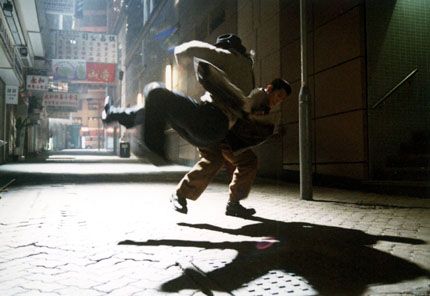
Andy LauThe weekend’s mail brought 2 of the new action films from Asian director Johnnie To. I watched Fulltime Killer (2001) first. Set in Taiwan, Macau, Hong Kong and Thailand the dialog is in Cantonese, Japanese and English with a little Korean thrown in for good measure. It’s the story of 2 dueling contract killers, a girl caught between them and the Hong Kong police detectives tracking all 3 of them. The sets, mostly urban, are lit and shot with a clean, sharp definition that draws one in. There are hundreds of these locations all looking pristine-beautiful and that alone would be worth seeing it.

The action never stops though. Fulltime Killer moves like a bullet train, without a second thought, to a final night time showdown at a fireworks warehouse and its double ending.

Johnnie To's ThrowdownNext day, time to take in Throwdown (2004), set entirely in Hong Kong and opening at night among the breezy reed beds along the edge of the city. The soundtrack jumps between Cantonese and English as the film features another threesome: an alcoholic nightclub owner resting on his laurels as throwdown champion, the challenger who becomes his partner and the ambitious woman who wants fame and success as a singer. Again, the locations have to be seen. The lighting for the night shots is exquisite. My eyes devoured every scene. And like Killer, Throwdown barrels down the line, weaving multiple plotlines together without pausing once for breath.

Neither film makes standard Hollywood sense: there is little romance, motives are murky. What the characters want to do is all that matters, but why they want to or how they feel as they succeed or fail is never dwelt upon.

Watching both these films I glimpsed a new world — modernist, crowded, a paper thin borderline separating life and death – where no one really cares. In shiny, dense city-jungles where most of humankind now live all that matters is keeping your wits, taking care your physical self, getting money to live well. Check it out!

One Dead in Ohio Part I

By Restless [Originally on goofyblog 10.21.07]

I left New York Thursday before Labor Day weekend. Tried Amtrak, which goes NYC, Cleveland, Chicago, then down to Albuquerque and over, ending in L.A. Sold out, try tomorrow.

Cabbed from Penn Station over to the Port Authority, where Greyhound always runs, always has space. During the 3-hour wait for departure, I stumbled into the little cafeteria I’d been in the very first night I came here: New Year’s Eve, 2002, and that’s saying something because the Port Authority Terminal is a multi-level maze of entrances, stairways, gates and shops in which one can easily get totally lost.

Back then, I’d driven 500 miles in my Geo Prism all the way from Columbus over the fogbound mountains of Pennsylvania, arriving in Secaucus, New Jersey, at 10 pm, where I finally found a motel room (major feat on New Year’s Eve – so many were by the hour only, on that night). At the bus stop into the City, I met a guy who took me under his wing, amused that I’d come all the way from San Francisco for New Year’s Eve in NYC.

The end of the line was the PA and my newfound friend took me 4 blocks down 8th Avenue to a bar full of show people in mid-celebration, where he intended to roost for the night. I wanted to go to Times Square though, so, telling him I’d come back after midnight, I started walking down Eighth, trying to find a way to get over to Seventh and Times Square, but because of “heightened security” the cops had blocked every street.

For 10 blocks I walked. After enduring 2 checkpoints, the crowd I was in was funneled into a “corral,” a half block-long area surrounded by blue barricades,manned by dozens of cops. In the distance we could see the Square. This was my first experience with what New York City had become.

I love crowd surfing, but we could only be good cattle this night. A couple years later, I discovered the police had completely crushed the Critical Mass movement by calling the bicyclists “terrorists,” setting safe biking in Manhattan back many years. They did the same thing during the Republican Convention in 2004, setting freedom in America back many years. I could only wonder if it had been any different before 9-11.

It was a mild night – high 40s. New Year’s came and went without much celebration. I noticed lots of girls hitting on the cops; it’s so true about some women and a uniform, ain’t it?, I walked back to the bar to find my new short, pot bellied friend completely shit-faced. He slurringly told me the 1st was his birthday and since I’m a Capricorn, too, I asked how old he was.

He was a year younger than me. Lordy! Is this what living in the East does to you? I found out later the answer to that question is — yes.

He’d spent all his money and I was in no mood to drink anymore, so we navigated the 4 blocks back to the Port Authority. Our departure gate was 2 floors below the street, but didn’t leave for 45 minutes. Next to the gate was that little cafeteria.

I was hungry and I figured my friend needed some coffee badly. So I bought a hot dog and coffee for me plus one for him. As I handed him the cup I witnessed the most truly amazing sight of the evening. He began by first twirling around right by the condiment counter experiencing the vertigo that sometimes comes from severe drunkenness. On the 3rd twirl, he began projectile vomiting. A few more twirls and he stopped, then fell flat on his back, a felled tree amongst the forest of high chairs and tables, still vomiting like a whale spewing water from its blowhole.

Then he passed out and started snoring. Without a second’s hesitation, a latin guy was at my side, discussing these events. Could he be having an epileptic seizure? An older black lady said leave him alone. Two Port Authority cops came in, hovering around him. He regained consciousness and wanted to catch his bus and go home, but the cops weren’t going to allow him to go anywhere except maybe to Bellevue or the drunk tank.

While he argued with them, I got on the bus. My East Coast adventure had begun.

And now 5 years later, here I was in that small restaurant again. An old woman sat next to me. She badly needed a shave and a bath. On the other side of her, a 30-ish dished-out blonde was reading the Post, pointedly ignoring my neighbor’s attempts to chat. Cursing the blonde and NYC in general, she told me she was on her way to an ashram upstate.

Go figure. Maybe she was my last beacon from the East. Had I come full circle?

The bus left on time, a no nonsense black driver at the helm. A Christian 3 rows back started explaining “things” to his Asian seatmate as if giving a sermon in the Church of Greyhound. He spoke for 6 hours straight. I’ll bet you didn’t know the infallibility of the Pope is protected by God: if the Blessed Father attempts to say something not true our Blessed Lord will knot up his tongue rendering our Blessed Vatican City Mayor speechless.

I hadn’t slept at all the night before, preparing for my departure. As I tried to doze off, the Christian’s subliminal sermon penetrated my brain like pincers from an Inquisitor’s torture cabinet: his parents were part of Opus Dei; our Heavenly Blessed Pope visited and forgave his Turkish assassin in his prison cell, and yadda yadda. Oy! I left New York for this?

We made one rest stop on the way to Pittsburgh, just in time for a sudden rainstorm. The girl down the aisle smiled at me as she passed me in the 7-11. The latin family across from me didn’t return to the bus within the 20 minutes allotted by our driver, causing him to drive to the freeway entrance and gun his motor for 10 minutes, fuming. When they finally ran up, wet and anxious, he lectured them severely. Chastened, we rode on through the night, making it to Pittsburgh at midnight for an hour layover to change buses and drivers.

[to be continued]

Back in Cali Again


By Restless [Originally on goofyblog 9.21.07]

The first day of fall and my summer vacation from blogs and all news is now over — and so is my life in New York. As it turned out, my summer vacation was really the end of the end.

My last post was of a panorama. I started a plog the other day and wrote:

It looked to be just another hot, humid summer in new york. This shot [the one I posted in July], taken at 10am, 7/2, on the Upper East Side, of the East River and Roosevelt Island, shows the hazy beginnings of one of those days. How clear was it becoming that things just weren’t going my way any longer, hadn’t been going my way for some years now. Very clear. Everyday brought more clarity: don’t stay here.

Then, a way opened, and I walked through. Good bye for now, new york. So much I’ve learned, understood. Paradoxically, I began to feel more boxed in, more typecast, more immobile there than anywhere else (except perhaps London if I’d lived there for longer than a few weeks).

But, things change and one can benefit from changing with them. Escape from New York. That’s that I’ve done — for now. And off on a wild bus ride across country.

And now. . .see the photo above. Landed in a housesit for the next 6 weeks, my friend visits Southeast Asia twice a year, where Western men over 40 are considered desirable still. He likes it and like I said, things just fell together and that’s a sign.

And after many hours walking the streets of Manhattan listening to Eckhart Tolle on my trusty iPod, I’m all about signs. Pay attention to them. They are all around you.

[to be continued]

P.S., click on the photo for a blow-up. Look at the cat in the center!

So Far So Good


By Restless [Originally on goofyblog 7.7.07]

Roosevelt Island, East River, July 1st 9am, 90°
(click for bigger)

3 weeks into the Summer and No Paris, no Bush, No Iraq. Just heat, humidity, rain and attitude here in the City. That and thousands of dogs, thousands of kids (neo-BabyBoom?), thousands of girls in summer party dresses parading in packs every night. Oy vey.

Summer Begins

By Restless [Originally on goofyblog 6.21.07]

Today is the first day of Summer. For the past few weeks I’ve been working long hours and fielding auditions and freelance deal. Today I read 39 Ways to Live, not Merely Exist at dumb little man. Some excerpts:

  • Love. Perhaps the most important. Fall in love, if you aren’t already.
  • Get outside. Don’t let yourself be shut indoors. Pay close attention to nature.
  • Take chances. We often live our lives too cautiously, worried about what might go wrong. Be bold, risk it all.
  • Follow excitement. Try to find the things in life that excite you, and then go after them. Make life one exciting adventure after another.
  • Turn off the TV. How many hours will we waste away in front of the boob tube? How many hours do we have to live? Do the math, then unplug the TV.
  • Pull away from Internet. You cannot get these minutes back. Unplug the Internet, then get out of your office or house. Right now! And go and do something.
  • Travel. Sure, you want to travel some day. When you have vacation time, or when you’re older. Well, what are you waiting for?
  • Rediscover what’s important. Take an hour and make a list of everything that’s important to you. Add to it everything that you want to do in life. Now cut that list down to 4-5 things. Just the most important things in your life. This is your core list. This is what matters. Focus your life on these things. Make time for them.
  • Eliminate everything else.
  • Exercise. Get off the couch and go for a walk. Or do some push ups and crunches. Whatever you do, get active, and you’ll love it. And life will be more alive.
  • and more.

Reading items like stop watching news (#33) and stop reading magazines (#31) got me to thinking: why not take a vacation — from everything as I know it.

A break from all those great John Pilger documentaries I had to download because they aren’t distributed in rental form in this country. Starting with his doc on the Cambodian genocide in the early 70s, on through his entertaining film on Coca Cola and Pepsi, their roots in the US and the world, on up to his latest, The War on Democracy, a history of US intervention in Latin America over the past 50 years, it’s been an interesting and educational journey. (Download the torrents in 4 iso’s at onebigtorrent).

And a break from my daily dose of democracynow, which just hosted Michael Moore for an outstanding interview on his new film about health care in the United States, “Sicko.” Going on hiatus as well from the great vid clips that come out on the net daily, like Hilary and Bill Clinton’s teaser replicating the final scene of “The Sopranos.”

It’s time to re-think, enjoy the outdoors and the heat, fall in love with New York, take chances. The photos below are my Madison Avenue - late Spring series.

I’ll see you this Fall.

Passionate Kisses


VideoJug: How To Kiss Someone Passionately

By Restless [Originally on goofyblog 6.11.07]

This Brit-made vid is a funny how-to on kissing. Check it out!

Link (from boing boing)

Wear your Rubbers: Updated


By Restless [Originally on goofyblog 6.6.07]

This animation is one of two promoting condom use in France. It’s a great little story, told well. The above is the straight one; the gay one can be found linked below. Check it out!

UPDATE: Violet Blue points to another ad from this series on videosift.com

Alberto Colin says,

I just wanted to let you know that this is part of a campaign that started in 2005. This is the video for 2005: Link. This is the video for 2006: Link. And this is the new video for 2007: Link.All done by Wilfred Brimo.

Steve LaNasa says,

There’s a third one: Link.

Link (Via boing boing)

Ron Paul Writes

By Restless [Originally on goofyblog 6.4.07]

Ron Paul, the wildcard at the Republican Presidential debates, writes in Daily Reckoning Australia about our diminishing influence and “dollar diplomacy:”

Though money developed naturally in the marketplace, as governments grew in power they assumed monopoly control over money. Sometimes governments succeeded in guaranteeing the quality and purity of gold, but in time governments learned to outspend their revenues. New or higher taxes always incurred the disapproval of the people, so it wasn’t long before Kings and Caesars learned how to inflate their currencies by reducing the amount of gold in each coin - always hoping their subjects wouldn’t discover the fraud. But the people always did, and they strenuously objected.

This helped pressure leaders to seek more gold by conquering other nations. The people became accustomed to living beyond their means, and enjoyed the circuses and bread. Financing extravagances by conquering foreign lands seemed a logical alternative to working harder and producing more. Besides, conquering nations not only brought home gold, they brought home slaves as well. Taxing the people in conquered territories also provided an incentive to build empires. This system of government worked well for a while, but the moral decline of the people led to an unwillingness to produce for themselves. There was a limit to the number of countries that could be sacked for their wealth, and this always brought empires to an end. When gold no longer could be obtained, their military might crumbled. In those days those who held the gold truly wrote the rules and lived well.

That general rule has held fast throughout the ages. When gold was used, and the rules protected honest commerce, productive nations thrived. Whenever wealthy nations - those with powerful armies and gold - strived only for empire and easy fortunes to support welfare at home, those nations failed.

Today the principles are the same, but the process is quite different. Gold no longer is the currency of the realm; paper is. The truth now is: “He who prints the money makes the rules” - at least for the time being. Although gold is not used, the goals are the same: compel foreign countries to produce and subsidize the country with military superiority and control over the monetary printing presses.

Since printing paper money is nothing short of counterfeiting, the issuer of the international currency must always be the country with the military might to guarantee control over the system. This magnificent scheme seems the perfect system for obtaining perpetual wealth for the country that issues the de facto world currency. The one problem, however, is that such a system destroys the character of the counterfeiting nation’s people - just as was the case when gold was the currency and it was obtained by conquering other nations. And this destroys the incentive to save and produce, while encouraging debt and runaway welfare.

The pressure at home to inflate the currency comes from the corporate welfare recipients, as well as those who demand handouts as compensation for their needs and perceived injuries by others. In both cases personal responsibility for one’s actions is rejected.

When paper money is rejected, or when gold runs out, wealth and political stability are lost. The country then must go from living beyond its means to living beneath its means, until the economic and political systems adjust to the new rules - rules no longer written by those who ran the now defunct printing press.

For more of Ron Paul’s article, including his analysis of the genesis of dollar diplomacy, creation of the Federal Reserve, beginning and end of the Bretton Woods Agreement, his exchanges with Allen Greenspan, the U.S.’s swap of gold-backed paper money to oil-based and much more, go here.

Packing Heat at Day Care


By Restless [Originally on goofyblog 6.1.07]

Howard David Ludwig — affectionately nicknamed Bubba — received his state-issued Firearm Owner’s Identification Card two weeks ago.

Howard Ludwig was able to get his son Bubba a FOID card.
(Brett Roseman/Daily Southtown)

The wallet-size card arrived in the mail about a month after his dear ol’ dad correctly completed the online form and sent the $5 fee.

As a FOID cardholder, baby Bubba can own a firearm and ammunition in Illinois. He can also legally transport an unloaded weapon — though he can’t walk yet, so that’s not an issue.

The plastic card has a picture of a toothless, grinning Bubba in the upper right corner. It includes his name, address and date of birth.

The FOID card lists his height (2 feet, 3 inches), and his weight (20 pounds).

Link.

I yam what I am

By Restless [Originally on goofyblog 5.31.07]

Bodybuilders seeking more impressive physiques are flocking to a newer dysmorphia product. Synthol binds with the muscle fibers to create a bloated appearance, or instant bulk. Without any weight training, recipients of the injections can end up with arms larger than their legs.

Link (from grow a brain)

What Happens to Great Empires

By Restless [Originally on goofyblog 5.25.07]

Mike Whitney at Smirking Chimp has posted a most provocative interview with Elaine Meinel Supkis. I’ve been meaning to write something about the dismantling of the post-WWII Bretton Woods agreement by Nixon in ‘71 when he discovered he couldn’t simultaneously maintain a stable world currency and conduct an expensive, losing war in Vietnam, and what his decision has cost us since into the present, but I think she does that more eloquently than I ever could. Here an excerpt of a part of her long intereview.

Elaine Meinel Supkis: Great Depressions like the one that hit in 1929 are very rare. They usually happen only after two great empires exhaust their finances. WWI involved two of the biggest industrial powers in a massive death-struggle that didn’t destroy their industries but wrecked their currencies and beggared their workers. Russia was a major empire but a minor industrial power so when the workers there revolted, the loss of this sector’s industrial base had much less impact than the collapse of Germany’s currency and its huge war debts.

This chart [not pictured] is from one of my most dog-eared books, one of the greatest works explaining relative power and why empires collapse, ‘The Rise And Fall Of The Great Powers‘ by Paul Kennedy. The chart shows how England, the leading nation in the world, supposedly the richest, spent the most money during that grinding, depressing stalemate of a war.

Germany spent $3.9 billion less than England. Inflation since 1913 has been ferocious. This probably would represent well over several trillion dollars in today’s currency. Even today, no nation can take a financial hit that big and stay solvent. Europe’s industrial production fell 30% and the US, fattened off of billions of dollars of loans to all parties in Europe, lived high and mighty during the 1920’s. But with industrial production lagging, Europe spiralled downwards. The US cheerfully gave everyone more and more loans and the promise of being repaid was fantastic! Why, these were basically AAA subprime loans.

Then Germany couldn’t pay and kept asking for better terms. This was OK with the US but not with bankrupt England or France. So they demanded full payments and Germany defaulted. This triggered the Great Depression. Even though the US was now the world’s largest manufacturing power, our currency was mostly for home use so the British had to keep the pound strong. Trying to do this made things worse.

And so it is today: our empire won’t retreat from its distant borders but these same borders are bankrupting us for we never recovered from the Vietnam War, we literally papered over the mess which remained and continues to poison our nation. The military/industrial complex is not making us rich, it is making us poorer. And the paper being laid over all this is the same paper the Germans used in 1924 to paper over their own bankruptcy: printed money.

When an empire does what we are doing today, society falls apart. And if this happens, there is no easy way out. Individuals can avoid the worst by avoiding debts but outside of that simple thing, there is no other answer. Of course, the true answer is a strong working class that believes in unity and not underselling each other. Alas, the USA has a long and tragic history of slavery. And the legacy of this culture divides the nation and half loves slavery and enables wretched working conditions and thinks the road to wealth is via cheap labor.

Germany has an advantage here: their recent attempt at slavery, the Nazi empire, was a total disaster and they don’t want a repeat. I only wish the USA felt the same way. For no nation gets very rich for very long if the working class is poor and can’t work their way into the middle class.

Further on:

In the case of empires, a way to gage solvency is, how big is their own reserves compared to the size of these same currency reserves held by potentially hostile rivals? In the case of the USA, we send dollars out as fast as we can print them. If too many people getting this flood of money, around $800 billion a year now!!!!!! If they don’t keep a big chunk in bank vaults, the value of the dollar drops. So they keep it in reserve, in case of a ‘rainy day’. Like 9/11.

And if we think of these funds as boats, then China has Noah’s Ark, Japan has an aircraft carrier, Europe has a holiday cruise liner, Russia has a very fancy yacht and the USA has a rowboat made out of an old bathtub. That is leaking.

Finally:

Question: Will you explain how the inflationary policies of the Federal Reserve are causing the stock market to soar and what the potential dangers are for the global economic system?

Elaine Meinel Supkis: Oh, that is so simple! In 2003, interest rates were dropped to 1% despite inflation of +5%. Instantly, the value of all assets shot upwards as bankers moved money along as fast as possible since the Fed undercut their own interest rates! So mortgages were below the rate of inflation. But this didn’t make enough money so banks and other entities offered loans to bad risks who had to pay a higher rate. As inflation rages, they need to give loans to worse and worse customers who pay over 11% interest!

Alas, the fly in this ointment is exactly that: risky customers can’t pay back loans! They go bankrupt and everyone acts like a good little domino and over they fall, one after another. Right now,the crashing sound of dominoes falling is like the hissing of waves on a distant shore but it is rapidly approaching. We can certainly hear it coming.

Elaine’s blog is here.

The Case of the Wrecked Republic

By Restless [Originally on goofyblog 5.24.07]

I’m part way into the 3rd in Chalmers Johnson’s trilogy about the U.S. Republic versus the U.S. military-industrial-congressional complex. Johnson is professor emeritus at U.C. San Diego and was an outside consultant to the CIA in the late 60s through the early 70s.

In 2000, his first, Blowback, was published. It’s a recounting of the incredible history of CIA covert dirty tricks and overt military actions by our Armed Forces during the last 60 years. His premise, that the things we’ve done to other governments and peoples of the world will “blowback” on us, predated the 9-11 attacks by a year. This book appears to be the basis for Ron Paul’s controversial statements during the recent Republican debates wherein he pointedly used the word “blowback” several times.

Professor Johnson takes the reader around the world, country by country (Korea, Okinawa, Afghanistan, Russia, Iran, Iraq, the nations of Central and South America) recounting events and facts commonly known to other countries but little-known in our own. It is crystal clear we’ve had an out of control intelligence apparatus that not only threatens the sovereignty of other nations but of our freedoms and our democratic form of government.

Chalmers goes back into our history relating what the Founding Fathers wrote and said about the dangers of a free-standing military and the dangers of foreign wars. He goes even further back to the roots of why the Founders came to those conclusions: the lessons they learned from the recent history of their times and their knowledge of the strengths and weakenesses of the Roman republic. Taking all of this knowledge and thought they constructed an intricate system made specifically to distribute power evenly so that no one person or branch or group could ever gain power.

In 2004, he published the 2nd, The Sorrows of Empire: Militarism, Secrecy, and the End of the Republic. A lot had happened since Blowback had come out: 9/11, the war in Afghanistan and the invasion of Iraq. Sorrows of Empire makes the case in thoroughly convincing, chilling terms: secret government and militarism in the populace and in political leaders is the end of republican government in the United States. Just his history of the CIA since its inception makes the book worth reading. But there is much more.

At the end of the book he says:

There is one development that could conceivably stop this process of overreaching: the people could retake control of Congress, reform it along with the corrupted elections laws that have made it into a forum for special interests, turn it into a genuine assembly of democratic representatives, and cut off the supply of money to the Pentagon and the secret intelligence agencies.

We have a strong civil society that could, in theory, overcome the entrenched interests of the armed forces and the military-industrial complex. At this late date, however, it is difficult to imagine how Congress, much like the Roman senate in the last days of the republic, could be brought back to life and cleansed of its endemic corruption. Failing such a reform, Nemesis, the goddess of retribution and vengeance, the punisher of pride and hubris, waits impatiently for her meeting with us.

I’ve just started the final book in his trilogy, Nemesis: The Last Days of the American Republic, which came out late last year. He opens the book with this:

Empires do not last, and their ends are usually unpleasant. Americans like me, born before World War II, have personal knowledge – in some cases, personal experience – of the collapse of at least six empires: those of Nazi Germany, imperial Japan, Great Britain, France, the Netherlands, and the Soviet Union.

If one includes all of the twentieth century, three more major empires came tumbling down – the Chinese, Austro-Hungarian, and Ottoman. A combination of imperial overstretch, rigid economic institutions, and an inability to reform weakened all these empires, leaving them fatally vulnerable in the face of disastrous wars, many of which the empires themselves invited.

In Nemesis, he details the NSA wiretapping going on, the secret and not secret military bases around the world, the phantom military and intelligence spending budget completely removed from scrutiny and any oversight, and the history and now prevalence of the unitary Executive.

On May 15th, Johnson posted Is Imperial Liquidation Possible for America? on The American Empire Project blog (picked up as Can We End the American Empire Before It Ends Us? on AlterNet). He opens with the following:

In politics, as in medicine, a cure based on a false diagnosis is almost always worthless, often worsening the condition that is supposed to be healed. The United States, today, suffers from a plethora of public ills. Most of them can be traced to the militarism and imperialism that have led to the near-collapse of our Constitutional system of checks and balances. Unfortunately, none of the remedies proposed so far by American politicians or analysts addresses the root causes of the problem.

According to an NBC News/Wall Street Journal poll, released on April 26, 2007, some 78% of Americans believe their country to be headed in the wrong direction. Only 22% think the Bush administration’s policies make sense, the lowest number on this question since October 1992, when George H. W. Bush was running for a second term — and lost.

How did we get here? One reason is the state our “free” press is in:

Instead of uncovering administration lies and manipulations, the media actively promoted them. Yet the first amendment to the Constitution protects the press precisely so it can penetrate the secrecy that is the bureaucrat’s most powerful, self-protective weapon.

As a result of this failure, democratic oversight of the government by an actively engaged citizenry did not — and could not — occur. The people of the United States became mere spectators as an array of ideological extremists, vested interests, and foreign operatives — including domestic neoconservatives, Ahmed Chalabi and his Iraqi exiles, the Israeli Lobby, the petroleum and automobile industries, warmongers and profiteers allied with the military-industrial complex, and the entrenched interests of the professional military establishment — essentially hijacked the government.

The news and facts contained in these pieces make it clear the situation is dire: we are not headed away from empire, we are headed away from democracy.

Cool Illusions


By Restless [Originally on goofyblog 5.24.07]

Found this site the other day: a site devoted to illusion. Some are of the Magritte variety like the above (Who is Magritte, you say? See the below).

I like Magritte. Check out the Amazing Illusions blog!

Cool Vid


By Restless [Originally on goofyblog 5.23.07]

Men In Black is the hard hitting story of former Army infantryman Colby Buzzell and the ambush that he experienced in Mosul. Animated drawings bring this story to life, and the very expressive, reflective voice of Buzzell narrates you through the horrifying scene. If you need a reminder of just how real this war in Iraq really is, then prepare to be moved.

Link (Via Didn’t You Hear?)

Mel Helps Scotland Become Free

By Restless [Originally on goofyblog 5.22.07]

The Roxie on 16th near Valencia has a rolicking free-for-all on Academy Award evenings, or it used to. Come in with your friends and neighbors, even bring a bottle in a sack and laugh and cat call and boo or cheer the stars and the ceremony itself.

The last year I went there, Mel Gibson was up for something, so it surprised me that the Roxie crowd hated him enough to roundly boo him every time his name was mentioned. It was well before his drunken disintegration. I figured he must have said something homophobic somewhere, somehow.

A year or two later came The Passion of the Chist and if you caught even one of the interviews Mel was giving to promote the movie, you could tell that he had gone passionately crazy. At the time it came out, I was in a pretty religious area of the U.S. and I could witness whole churches and families going to see this “work” en masse, then maybe even going again.

I didn’t go, but a year or 2 later, when I rented it, I couldn’t bear to watch even the first 30 minutes. Yet, the movie made hundreds of millions and since Mel produced it on his own, he kept a large chunk of that. Last month, I caught Apocalypto off a pirate video stream and was surprised and impressed. A taut well-shot, acted and, especially, directed, bit of filmmaking it was.

Another film he did particularly welll was Braveheart. In fact, it’s such a great film, it might change history. Now comes this from the New York Observer, this week’s edition:

Last week, the Scottish National Party became the largest party—by one seat—in the Scottish Parliamentary election.

Credit for this development belongs, in no small part, to Mel Gibson—and to Braveheart.

Twelve years ago, when the epic adventure movie was first released, Scotland was a nation in name only. It was part of Great Britain, governed from London, with a London-based member of Parliament as secretary of state for Scotland. (He was booed at the premiere of the film.)

Since then, the Scots have established their own Parliament through devolution, giving them local control over disbursement of public money for things like health care, police and economic development.

Braveheart—a rollicking film that is the most prominent specimen in a genre in which Mr. Gibson covers himself in the blood of Englishmen—has helped take this a step further, transferring a calibrated campaign for local control of some spending to a cry for actual independence.

The Gibson-directed epic, released in 1995, was a creative reimagining of the story of William Wallace, the Scots warrior who, seven centuries ago, led his bedraggled army of rebel Highlanders to victory over the better-armed forces of the English king.

For many of today’s Scots, Mr. Gibson’s movie has become the definitive reading of their history.

Link.

Make Your Heaven

By Restless [Originally on goofyblog 5.21.07]

For the last 7 years that I lived in San Francisco (’95 - ‘02), Tracy Chapman was my neighbor across the street (mansion at right). While living there, I began to travel and explore the world — Europe, Chicago, Las Vegas, New York, Burning Man, all for the first time — until I decided to make traveling away permanent . . . for now.

When I moved in, Tracy had just released New Beginnings. The album went platinum 5 times and resuscitated her popularity. The hit, Give Me One Reason, got air play, but there were several other tracks that spell instant homesickness no matter where in the world I am.

Like the time I found New Beginnings on a juke box in a saloon in Virginia City, Nevada:

The world is broken into fragments and pieces
That once were joined together in a unified whole
But now too many stand alone There’s too much separation
We can resolve to come together in the new beginning

Start all over. Start all over. Start all over.
Start all over.

We can break the cycle - We can break the chain
We can start all over - In the new beginning
We can learn, we can teach
We can share the myths the dream the prayer
The notion that we can do better
Change our lives and paths
Create a new world

Its chanting call to action becomes more relevant as each day goes by.

Or the time in a smoky coffee house in Amsterdam musing to the lyrics & structure of Heaven’s Here on Earth:

You can look to the stars in search of the answers
Look for God and life on distant planets
Have your faith in the ever after
While each of us holds inside the map to the labyrinth
And heaven’s here on earth

We are the spirit the collective conscience
We create the pain and the suffering and the beauty in this world
Heaven’s here on earth

In our faith in humankind
In our respect for what is earthly
In our unfaltering belief in peace and love and understanding

The philosophy and ideals in these songs is San Francisco to me, a place where the thing called Burning Man could be born — just one small, relevant example. A place in the world that powerfully inspires those who live there to say and do what needs to be done.

Tracy moved away just a couple of months before I did. But I carry the feelings from the lyrics, chords and the arrangements on the New Beginning cd wherever I go.

Monday, April 13, 2009

Tattoo You


By Restless [Originally on goofyblog 5.19.07]

Discovered this gallery of unique (to say the least) tattoos while trolling.

Note: The above is one of the few work-friendly pics in the gallery.

Link (Via didn’t you hear?)

Cobra Wrastlin’


By Restless [Originally on goofyblog 5.17.07]

This vid ends before we discover who the winner is: the cobra or the baby. The cobra must be a pet and de-fanged?

Link (Via boing boing)

From Little Rock to Venice Beach


By Restless [Originally on goofyblog 5.16.07]

The first year I attended Burning Man (1998), I rented a huge RV and drove to my friends’ camp to the far north of city center arriving just after midnight on Wednesday. What an astonishing sight! I will never forget those first hours, listening to Bolero waft out from one camp, while from another I could see a small area well-stocked with beat up sofas full of a crowd eagerly watching old black and white television.

I didn’t know where my friends were exactly located so I parked the rv and used my bike to get to the message boards, found their note and pulled into their camp at about 1. My friends had been going to BM for a few years, but they were with their friends who had been going since the early 90s. When I told them I was going to rent an RV, they hooked me up with 2 of their friends who they had persuaded to attend for the first time as my roommates. Robin and Eric were from LA and the 3 of us newbies became instant companions for the next 5 days.

After it was over, the 3 of us drove in caravan (E & R in Eric’s car, me in the RV) to an RV park in Reno and slept for like 10 hours, then they split south and I split west.

Almost instantly after leaving, the thing that is Burning Man hit me and hit me hard. I missed it. By January I was missing my new friends as well and I persuaded Galen to drive down to Los Angeles and hang out with them. Galen, the friend that had originally got me into BM, had grown up in Los Angeles and still had many friends there.

We drove to Robin’s apartment in Venice and almost immediately she took us on a tour of the boardwalk. It was exotic, bizarre and I fell in love with this part of Los Angeles on first sight.

As we were walking up the boardwalk, the couple above jumped out of a store, dressed just like they are in the picture above, and started dancing and singing. Tres bizarre to say the least, but also very endearing.

This is why it’s a real treat to read about them and find out more about who they are. Elton and Betty came from Little Rock, where it seems Betty may have been a secretary to Hillary Clinton at one time. She had psych problems and was taking medication, but then decided to heave the meds and just be herself.

Somehow they found their way to L.A. and Venice. If you visit their myspace site you will be treated to Betty’s rendition of Paranoid Schizophrenia and Menopause Mama among other sterling dittys.

I’m so glad they are still doing their thing in the City of Angels.

Link.

It Was Always About Oil

By Restless [Originally on goofyblog 5.17.07]

As things get murked up in Washington regarding funding or de-funding the war, who’s pushing for an end, who’s sincere in bringing it to an end, Matt Taibbi checks in with his usual blunt analysis.

I’ve been reading the Chalmers Johnson trilogy, which details the U.S.’s consistent meddling in the affairs political and economic of other nations for the past half century and so I’ve had a chance to bone up on the whole neo liberal agenda (the IMF and World Bank). It’s shocking to say the least what we’ve been doing in the name of “helping” other countries.

And we’re doing it now in Iraq. Taibbi hones in on the Benchmarks that both parties are near unaminous in endorsing, supported closely and blindly by main stream media. The central precept of these benchmarks is the neocolonial Hydrocarbon law that the Iraqi government and people must endorse to “prove” they are able to govern.

The proposed Hydrocarbon Law is a result of pressure from the American government on the Iraqis to draft an oil policy that would adhere to the IMF guidelines. It allows foreign companies to take advantage of Iraqi oil fields by allowing regions to pair up with foreigners using what are known as “production-sharing agreements” or PSAs, which guarantee investing companies large shares of the profits for decades into the future. The law also makes it impossible for the Iraqi state to regulate levels of oil production (seriously undermining OPEC), allows oil companies to repatriate profits, and would also allow companies to hire foreign workers to man facilities. Add all the measures up and the Hydrocarbon law not only takes control of the oil industry away from the Iraqi state, but virtually guarantees that the state will profit very little from future oil exploitation.

Now, I live in America and have been known to drive a car occasionally and I also understand something else — when mighty industrial countries need oil or anything else, they’re going to take it. They’re also unlikely to acquiesce forever to the whims of an organization like OPEC out of mere morality and decency, when military power can change the equation. Anyone who’s going to be shocked, shocked by this kind of shit had better be prepared to live in a tent and eat twigs and berries instead of African cocoa or Central American sugar or any of the millions of other products we basically steal from hungry, dark-skinned people around the world on a daily basis.

But I’ll tell you what I can do without. I can do without having to listen to American journalists, as well as politicians on both sides of the aisle, bitch and moan about how the Iraqi government better start “shaping up” and “taking responsibility” and “showing progress” if they want the continued blessing of American military power.

From any vantage point outside the U.S., the Hydrocarbon law can be seen for what it is. Not here though and the Dem’s endorsement of it strengthens the insurgency making the situation worse not better. It’s more of the same stuff I wrote about in February (Early Histories II: Iraq). There is a reason why we are building a gigantic embassy and multiple secret and not so secret military bases there. Now, it is crystal clear, for all the world to see.

Moreover, let’s just say this about the Democratic Party. They can wash their hands of this war as much as they want publicly, but their endorsement of this crude neocolonial exploitation plan makes them accomplices in the occupation, and further legitimizes the insurgency. It is hard to argue with the logic of armed resistance to U.S. forces in Iraq when both American parties, representing the vast majority of the American voting public, endorse the same draconian plan to rob the country’s riches. This isn’t a situation in which there’s going to be a better deal down the road, after Bush gets thrown out of office. Looking at it from that point of view, peaceful cooperation with the Americans is therefore probably impossible for any patriotic Iraqi; the economic consequences are too severe.

(A side note: there’s also an argument to be made that the smart play for the Iraqis is to cooperate now, and then tear up any agreement made with the Americans once they get their troops out. The instant our army leaves, any “laws” passed now under American pressure will be meaningless anyway. Yeah, sure, take all the oil you want… hey, do you want these bath towels, too? Oh, wait, you’re leaving? You sure you can’t stay? Etc.)

The media’s complicity in parroting the party line here as a kind of “tough love” way for the Iraqis to finally deserve our troop withdrawal may keep most Americans in the dark, but it’s not doing it for Iraqis, the people of the Middle East or the rest of the world.

This is no way to end the killings and the occupation. (Via AlterNet)

The Loser

By Restless [Orginally on goofyblog 5.15.07]

Patrick Cockburn, author of The Occupation: War and Resistance in Iraq, has written an analysis about the damage the Iraq war has done to America as a superpower. In his 5-page post on AlterNet, he makes it concretely clear what a monumental mistake it has been.

Moreover, even though U.S. covert policy is to stay in Iraq forever (gigantic embassy and military bases belie any statements to the contrary), the people of the Middle East just won’t allow that to happen. They win, we lose.

The war in Iraq that started in 2003 has now lasted longer than the First World War. Militarily, the conflicts could not be more different. The scale of the fighting in Iraq is far below anything seen in , but the political significance of the Iraq war has been enormous. America blithely invaded Iraq to overthrow Saddam Hussein to show its great political and military strength. Instead it demonstrated its weakness. The vastly expensive U.S. war machine failed to defeat a limited number of Sunni Arab guerrillas. International leaders such as Tony Blair who confidently allied themselves to Washington at the start of the war, convinced that they were betting on a winner, are either discredited or out of power.

At times, President Bush seemed intent on finding out how much damage could be done to the U.S. by the conflict in Iraq. He did so by believing a high proportion of his own propaganda about the resistance to the occupation being limited in scale and inspired from outside the country. By 2007, the administration was even claiming that the fervently anti-Iranian Sunni insurgents were being equipped by Iran. It was a repeat performance of U.S, assertions four years earlier that Saddam Hussein was backing al-Qaeda. In this fantasy world, constructed to impress American voters, in which failures were sold as successes, it was impossible to devise sensible policies.

The U.S. occupation has destabilized Iraq and the Middle East. Stability will not return until the occupation has ended. The Iraqi government, penned into the Green Zone, has become tainted in the eyes of Iraqis by reliance on a foreign power. Even when it tries to be independent, it seldom escapes the culture of dependency in which its members live. Much of what has gone wrong has more to do with the U.S. than Iraq. The weaknesses of its government and army have been exposed. Iraq has joined the list of small wars — as France found in Algeria in the 1950s and the Soviet Union in Afghanistan in the 1980s — that inflict extraordinary damage on their occupiers.

Link

What have I done to deserve such a fate
I realize I have left it too late
And so it’s true, pride comes before a fall
I’m telling you so that you won’t lose all

I’m a loser
And I’m not what I appear to be

- The Beatles

L, L, L 3

By Restless [Originally on goofyblog 5.15.07]

I love New York in late-spring, especially in evenings. Warm, but breezy, the city takes a rest about midnight in the mid-week. Walking or biking around an almost deserted Manhattan — like being in SF on a balmy Indian Summer night.


Self-Portrait, midnight Spring 2007


Small Park, Upper East Side


A cab when you need one.

American Idiot: John McCain

By Restless [Originally on goofyblog 5.14.07]

This letter from Cecile Richards, head of Planned Parenthood Action Fund, to the John McCain election committee says much about where the party of Arizona Republican Barry Goldwater is going, with McCain’s lead foot on the accelerator.

May 9, 2007

The Honorable John McCain
John McCain 2008
P.O. Box 16118
Arlington, VA 22215

Dear Senator McCain:

I’m writing in response to recent comments about Planned Parenthood made by your campaign.

As you know, there was a time, not too long ago, when you and other Republican candidates for office reflected the beliefs of most Republicans: that individuals have the right to make personal, private and responsible decisions about their health, their families and their futures — based on accurate, unbiased information and free from government intrusion and mandates.

In short, much of the Republican Party once shared the core principles of Planned Parenthood — the nation’s leading reproductive health care advocate and provider.

That is precisely why it’s so very disappointing to see the troubling turn your campaign has taken — particularly the recent incendiary remarks made by your key strategist John Weaver, who, according to The Los Angeles Times, called Planned Parenthood “one of the most radical pro-abortion groups in the country.”

Millions of U.S. women, men and teens from the reddest of red states to the bluest of blue states — including more than 80,000 Arizonans — rely on Planned Parenthood every year for cancer screening, breast exams, family planning, medically accurate sex education, birth control and abortion services. We would hope that you and your advisers would recognize and respect Planned Parenthood’s 90-year-old commitment to providing quality information and care.

In light of your most recent attack on Planned Parenthood’s vital health care mission — driven by the need to score political points for your campaign — I feel compelled to point out that some of your most generous donors are also some of Planned Parenthood’s strongest supporters. In fact, Planned Parenthood in Arizona was founded by Republicans, including Mrs. Barry Goldwater and Mrs. Maie Bartlett Heard.

Before your campaign lobs another attack on Planned Parenthood’s trusted reproductive health care services, I strongly urge you to consider the health and well-being of the millions of individuals and families who support and benefit from Planned Parenthood services every day in communities nationwide.

Sincerely,

Cecile Richards
President
Planned Parenthood Action Fund

God’s Architect


By Restless [Originally on goofyblog 5.14.07]

Found this great post about 10 Divinely Designed Churches today. I’ve always been fascinated by the works of the Catalan architect Gaudi and used to have a dozen pics of his works up in my apartment in San Francisco, however I don’t know much about the man other than the coolness of his work.

The construction of the Sagrada Familia basilica started in 1882, directed by Catalan architect Antoni Gaudí, who devoted his life to it. When people said that the construction had taken a very long time, Gaudí replied that he was building the church for God, and that his client wasn’t in a hurry. He then became known as “God’s Architect.”

In 1926, Gaudí got run over by a street car. Because of his raggedy attire and empty pockets, no one wanted to take him to the hospital. Eventually, he was taken to a pauper’s hospital where no one recognized him until his friends found him and tried to move him to another hospital. Gaudí refused, saying that he belonged with the poor, and died a few days later.

Because Gaudí refused to work with blue prints, preferring to use his imagination and memory instead, construction of La Sagrada Familia was halted after his death. Part of the church was even burnt during the Spanish Civil War. Construction of La Sagrada Familia was restarted afterwards and continues until today.

The article has 9 other fantastic churches & cathedrals plus some bonus postings. Check it out!

Update: BBC reports La Sagrada Familia is threatened by the construction of a subway very close to the foundation of the cathedral. The cathedral receives over 2 million visitors a year.

Odd 20th Century Ads


By Restless [Originally on goofyblog 5.11.07]

Whether it’s the zombie children, the pig that slices itself up, the Nembutal® Elixir for children or the sales of Lysol as a vaginal douche, this long page of ads, mostly from the first half of the 20th century, catch the eye.

Bayer Heroin was sold all over the world for over a decade until Bayer stopped making it in 1913. By 1914 it was illegal without a prescription. Initially it was seen as a godsend for tuberculosis and pneumonia patients (the 2 leading causes of death at the time) because it supressed the debilitating coughing of both ailments.

Bayer’s other product, Aspirin, was launched the same year. Of the 23 countries Bayer sold their heroin to, the U.S. was “where it really took off was the US, where there was already a large population of morphine addicts, a craze for patent medicines, and a relatively lax regulatory framework.”¹

Link (Via neatorama)

¹ from How aspirin turned hero.

Empire of Oil

By Restless [Originally on goofyblog 5.10.07]

Camp Bondsteel, the biggest “from scratch” foreign US military base since the Vietnam War is near completion in the Yugoslav province of Kosovo. It is located close to vital oil pipelines and energy corridors presently under construction, such as the US sponsored Trans-Balkan oil pipeline. As a result defence contractors—in particular Halliburton Oil subsidiary Brown & Root Services—are making a fortune.

Paul Stuart
29 April 2002

AMY GOODMAN: Can you talk about the private military contractors?

CHALMERS JOHNSON: It’s a business that’s developed, above all, in the 1990’s. It was Cheney’s idea when he was Secretary of Defense in the first Bush administration — that allegedly, to save money, they were going to start privatizing numerous activities in the armed forces that, until then, were performed by soldiers on active duty.

This — He sent out a contract to the Brown & Root division of Halliburton — a very famous old company that bankrolled the lives of Lyndon Johnson and many other famous Texas politicians.

He gave a contract to Brown & Root to estimate how they might start privatizing the various activities in the armed forces. Then he turned around and gave Brown & Root the contract to carry out their plan and as he left the government at the end of the Bush administration, Cheney went on a couple of years late to become the president of Halliburton, which is the company that owns Brown & Root.

Basically it means today that a soldier in the armed forces doesn’t have any of those experiences that were present there in World War II or Korean or Vietnamese wars.

People don’t do guard duty. They don’t clean up the barracks. They don’t clean the latrines. They don’t do kitchen police, so-called K.P.

That’s all done for them by private contractors. It is extremely lucrative and the way the contracts are written, profits are guaranteed. It is impossible to lose on these things.

Perhaps the greatest example is camp Bondsteel in Kosovo in the Balkans, which is the most expensive base that we’ve built since the Vietnam war. It was built entirely by Brown & Root.

It is today operated for the government by Brown & Root, just as are the bases in Kyrzakstan, in Turkey, and many other places of that sort. It is a huge growing business.

Interview of Chalmers Johnson by Amy Goodman of DemocracyNow, October 2003

Location, Location, Location

By Restless [Originally on goofyblog 5.7.07]

Almost a year ago, I started posting on goofyblog with the lead On Location. Writing about things I see and read answered a need to express that had been long dormant.

I’ve always read a lot of current affairs materials, and, in the past, when I’d see a particular news item or editorial that hit the nail on the head, I’d clip it and file it. My way of saying “Right on, there are others out there who put things together in ways that matter to me, that speak the truth well.”

Now I can bounce those truths right back out there and share them. With the advent of blogs, so many are coming out giving voice to their ideas and opinions. It’s suddenly crowded — and connected — and that’s just great.

You lose yourself, you reappear
You suddenly find you got nothing to fear
Alone you stand with nobody near
When a trembling distant voice, unclear
Startles your sleeping ears to hear
That somebody thinks
They really found you.

A few months ago, I started my own blog, Liberty Hill Blogger, which has mostly reposts of my goofyblog stuff, with some extras. The side bar is always full of compelling articles that I’m not going to write about, but feel are interesting enough to warrant a looksee.

I’ll celebrate my almost-anniversary over the next few weeks by posting shots of NYC the way I see it.


Chelsea Hotel
.

Thanks for reading. And remember:

While preachers preach of evil fates
Teachers teach that knowledge waits
Can lead to hundred-dollar plates
Goodness hides behind its gates
But even the president of the United States
Sometimes must have
To stand naked.

[top and bottom verse, Bob Dylan 1964]

A Folk Song for Dark Times

By Restless [Originally on goofyblog 5.4.07]

I guess I’m really just an old hippie. But you see, that word doesn’t mean the same to me as it does to those who use it now. Because being a “hippie” in the late ’60s - early ’70s meant living through a series of Constitutional crises, public demonstrations full of riot police, clashes with draft boards.

I don’t know how to tell you this in any other way: to a lot of us, it started looking like we were headed towards a dictatorship. It didn’t happen: the demonstrations against the Vietnam war and the draft, along with the Watergate revelations, topped with the Supreme Court’s backing of freedom of the press in the New York Times publication of the embarassing and revelatory Ellsberg papers turned things around. The heavy casualties of the losing war aided the change.

Our 2 other branches (Judicial and Legislative) acted decisively to limit an out of control Executive; the 4th Estate came through with extremely damaging evidence of Exectutive misconduct; whistelblowers like Daniel Ellsberg succeeded in revealing the extent of the deceit in our war policies.

You know how after a highly-publicized trial, if the defendant gets acquitted, he’ll usually say something like: “My faith in the American system of justice is restored! God Bless America!”

That’s how we felt in 1973.

But, in 1972, in the darkest hours, the following song began being broadcast on FM stations in the Bay Area. I thought of it the other day and found the full verse on Blue Gal’s blogsite.

When you read the lyric, I know you’ll think a great deal of it is quaint — the references to being persecuted for looking like Jesus or like a “sister,” speaking Spanish on a plane (all the hijakers of the era wanted to go to Cuba), laying around the house smoking marijuana — it’s got more hippy in it than I recall.

But I’m sure a few of the lines will stick with you.

Oh, mommy
I ain’t no commie
I’m just doing what I can
To live the good all-American way

It says right there in the Constitution
It’s really A-OK to have a revolution
When the leaders that you choose
Really don’t fit the shoes

Oh, mister
I ain’t no sister
I believe in the Bill of Rights
Come on, don’t you start a fight, please

I like to wear my hair long
How can there be anything wrong
When you already accused me twice
Of looking like Jesus Christ, Hallelujah

I’m only gettin’ tired of playing Punch and Judy
I’ve really half a mind to go and do my duty
Like Mr. Patrick Henry said
I got to be free or dead

Mr. Nixon
I ain’t a-fixin’
To speak Spanish on a plane
Or polish off the Liberty Bell

I just want to sit here on the shelf
And watch you finish off the place by yourself
Please let me do what I wanna
I’ll just lay around the house and smoke marijuana

It says right there in the Constitution
It’s really A-OK to have a revolution
When the leader that you made
Just don’t make the grade

Oh, mommy
I ain’t no commie
But I hate to bust your bubble
Cause there’s gonna be some trouble soon

(Brewer and Shipley, 1972)

The Ninth Amendment

By Restless [Originally on goofyblog 5.2.07]

The enumeration in the Constitution, of certain rights, shall not be construed to deny or disparage others retained by the people. –The Ninth Amendment

Last fall, I wrote about Justice Scalia’s idiotic interpretation of the constitution in regard to Roe v. Wade and the right to privacy (Scalia vs. de Tocqueville).

Now comes a book, addressing this interpretation and elaborating on one of the Amendments in our Bill of Rights, the 9th. I had no idea the right of privacy was already guaranteed by this amendment. The book couples the 9th with the 14th, which was passed after the Civil War and was meant to guarantee the “other rights” (guaranteed federally by the 9th) to include the states. A few excerpts:

As a former law professor at the University of Chicago and the University of Virginia, and now as a judge, Scalia has spent years working out an elaborate constitutional theory of originalism. He has consistently dissented from the entire line of human rights cases, arguing that abortion, gay rights, and end-of-life decisions should all be left entirely to the political process. This is a view that has powerful backing outside the Supreme Court.

Nothing is more anathema to these critics than the Court’s reliance on foreign judicial precedents as a source of guidance in interpreting the Constitution. Justice Scalia warned of the Court’s “dangerous” references to foreign law, adding that “this Court … should not impose foreign moods, fads, or fashions on Americans.” He and his fellow critics see no connection between broader conceptions of human rights and constitutional law. They refuse to look seriously at what the Framers believed, how they saw the world.

The author is Daniel A. Farber, the book, forthcoming on April 30th, is Retained by the People: The ‘Silent’ Ninth Amendment and the Constitutional Rights Americans Don’t Know They Have. More. . .

The Ninth Amendment is key to understanding how the Founding Fathers thought about the liberties they expected Americans to enjoy under the Constitution. They did not believe that they were creating these liberties in the Bill of Rights. Instead, they were merely acknowledging some of the rights that no government could properly deny.

The history of the Constitution reveals the purpose of the Ninth and the Founders’ intent: to protect what constitutional lawyers call unenumerated rights — those rights the Founder assumed and felt no need to specify in the Bill of Rights. Unenumerated rights include, for example, the right to privacy. In the America of today, unenumerated rights account for freedoms like a woman’s right to abortion. …

The truth is that anyone interested in the political and legal issues of the day can and should look to the Ninth Amendment for guidance.

Via AlterNet

Google Searches on Grandfathers at the Canadian Border

By Restless [Originally on goofyblog 5.1.07]

Vancouver psychotherapist Andrew Feldmar has been barred from entering the United States. The reason? During a random stop-and-search at a US/Canadian border crossing, a Google search of his name led to his article from the Spring 2001 ‘Janus Head: Journal of Interdisciplinary Studies in Literature, Continental Philosophy, Phenomenological Psychology, and the Arts.’ In it Feldmar describes two acid trips he took under the supervision of his graduate advisor in psychology — in 1967. This turns out to have been enough to earn him a life-time ban under the grounds of ‘admitted drug use.’

“Feldmar *was* told he could apply for a waiver, and that after a year, and at a cost of around $3,500, he had a ‘90% chance’ of its being granted.

“Oh — and he’d have to go through the process each time he wanted to travel to the US.”

Who is Feldmar?

Born in Hungary to Jewish parents as the Nazis were rising to power, Feldmar was hidden from the Nazis during the Holocaust when he was three years old, after his parents were condemned to Auschwitz. Miraculously, his parents both returned alive and in 1945 Hungary was liberated by the Russian army. Feldmar escaped from communist Hungary in 1956 when he was 16 and immigrated to Canada. He has been married to Meredith Feldmar, an artist, for 37 years, and they live in Vancouver’s Kitsilano neighbourhood. They have two children, Soma, 33, who lives in Denver, and Marcel, 36, a resident of L.A. Highly respected in his field, Feldmar has been travelling to the U.S. for work and to see his family five or six times a year. He has worked for the UN, in Sarajevo and in Minsk with Chernobyl victims.

Link (Via boing boing)

Back When We Cared

By Restless [Originally on goofyblog 5.1.07]

After WWI, the veterans coming home were forgotten about. There were promises made, but not kept, years of delays (for some, until 1946, 26 years after war’s end!). These frustrations led to the march and consequent live-in at Washington during the Hoover Presidency. This “insurrection” was put down by General MacArthur, but it left a bad taste in everyone’s mouth, including incoming President Franklin Roosevelt.

So, when the time came to take care of returning veterans of WWII, the GI Bill was passed. This turned out to be the single most important decision in history for the American middle class and our society in general, yet now it seems forgotten as was the plight of the veterans of WWI so long ago.

In light of what’s happening to the veterans of the gulf wars and the decimation of the middle class over the past several decades, as well as all the right-winger talk about “doing it for yourself,” take a look at Taylor Branch’s review of 3 recently released books on this topic.

The GI Bill was seen for years as a historic jackpot, spilling opportunity upon survivors, bystanders, and clueless progeny alike, but then vanished so completely from public discourse that perplexed scholars now search a cold trail.

For her book Soldiers to Citizens, political scientist Suzanne Mettler sent an extensive questionnaire to two thousand World War II veterans. Hoping for the usual return rate of fifteen percent, Mettler was astonished to receive completed forms from nearly three quarters of the veterans, many of whom volunteered life-changing narratives from six decades ago.

She applied her data to the difficult task of isolating the effect of government benefits from other factors, such as the broadening experience of World War II duty itself, and her results confirm estimates by social scientists that the GI Bill added nearly three years to the average veteran’s education.

“My central finding,” she writes, “…is that the GI Bill’s education and training provisions had an overwhelmingly positive effect on male veterans’ civic involvement.” [B]ut she openly regrets that the democratic surge dissipated within the working lives of GIs themselves. “Beginning in the 1970s,” Mettler concludes, “Americans began to vote less, to trust each other less, to trust government less, and to disengage from political parties and other forms of political action.”

In Over Here, journalist Edward Humes explores the subject anecdotally.

Humes describes Richard Koch, one of nine dirt-poor siblings on an immigrant sheep farm in North Dakota, who became a bombardier, German POW, then GI student, and now is called “Dr. PKU” for his pioneer medical treatment of children born with the insidious disease phenylketonuria.

The book follows Bob Booth, a young carpenter and submarine chaser mired in odd jobs until he stumbled upon the GI Bill and came to invent a silicone substance that made possible the first reentry spacecraft by enduring 6,000-degree heat.

Humes summarizes the careers of more familiar people launched from the GI Bill, such as the filmmaker Arthur Penn and senators George McGovern and Bob Dole.

Penn, the son of a Lithuanian watch repairer from Philadelphia, came home from infantry service in the Battle of the Bulge to meet ex-Marine Robert Rauschenberg at Black Mountain College with colleagues Merce Cunningham, Buckminster Fuller, and Jacob Lawrence, then created films spanning sensibility from The Miracle Worker on Helen Keller to the visionary portrait of violence Bonnie and Clyde. “I have a deep and abiding affection for the GI Bill,” Penn told Humes. “I can’t imagine what my life would have been without it.”

Both Mettler and Humes state that veterans’ benefits have been lowered steadily alongside a national decline in political optimism.

Each revision of the GI Bill since World War II has raised eligibility requirements while constricting assistance. The Vietnam law of 1967 tightened modifications from the Korean War. Recently, the Bush administration has sent the least favored military units to endure more than half of all US casualties in Iraq. “Members of the National Guard receive only a third of the GI Bill benefits that regular troops receive,” Humes pointedly notes, “and no benefits at all once they leave the service.”

The books are:

The Bonus Army: An American Epic
by Paul Dickson and Thomas B. Allen
Walker, 370 pp., $13.95 (paper)

Soldiers to Citizens: The G.I. Bill and the Making of the Greatest Generation
by Suzanne Mettler
Oxford University Press, 252 pp., $30.00

Over Here: How the G.I. Bill Transformed the American Dream
by Edward Humes
Harcourt, 319 pp., $26.00

Link to the review

The Empty Echo Chamber

By Restless [Originally on goofyblog 4.30.07]

This just in …

As the winds and water of Hurricane Katrina were receding, presidential confidante Karen Hughes sent a cable from her State Department office to U.S. ambassadors worldwide.

Titled “Echo-Chamber Message” — a public relations term for talking points designed to be repeated again and again — the Sept. 7, 2005, directive was unmistakable: Assure the scores of countries that had pledged or donated aid at the height of the disaster that their largesse had provided Americans “practical help and moral support” and “highlight the concrete benefits hurricane victims are receiving.”

Many of the U.S. diplomats who received the message, however, were beginning to witness a more embarrassing reality. They knew the U.S. government was turning down many allies’ offers of manpower, supplies and expertise worth untold millions of dollars. Eventually the United States also would fail to collect most of the unprecedented outpouring of international cash assistance for Katrina’s victims.

Allies offered $854 million in cash and in oil that was to be sold for cash. But only $40 million has been used so far for disaster victims or reconstruction, according to U.S. officials and contractors. Most of the aid went uncollected, including $400 million worth of oil. Some offers were withdrawn or redirected to private groups such as the Red Cross. The rest has been delayed by red tape and bureaucratic limits on how it can be spent.

In addition, valuable supplies and services — such as cellphone systems, medicine and cruise ships — were delayed or declined because the government could not handle them. In some cases, supplies were wasted. (…)

More than 10,000 pages of cables, telegraphs and e-mails from U.S. diplomats around the globe — released piecemeal since last fall under the Freedom of Information Act — provide a fuller account of problems that, at times, mystified generous allies and left U.S. representatives at a loss for an explanation. The documents were obtained by Citizens for Responsibility and Ethics in Washington, a public interest group, which provided them to The Washington Post.

In one exchange, State Department officials anguished over whether to tell Italy that its shipments of medicine, gauze and other medical supplies spoiled in the elements for weeks after Katrina’s landfall on Aug. 29, 2005, and were destroyed. “Tell them we blew it,” one disgusted official wrote. But she hedged: “The flip side is just to dispose of it and not come clean. I could be persuaded.”

Link (Via Obsidian Wings)

Saturday, April 11, 2009

She Watch Channel Zero

By Restless [Originally on goofyblog 4.30.07]

With good reason, Danny Schechter writes in A Media Scandal a Day Keeps the Ratings in Play, here, that there is wayyyyyyyy too much coverage on which prositute which official met last night and no coverage on what really counts — wide-spread corruption and incompetence in our institutions that can and will affect millions of us.

Who cares about the sex and these guys??? Here’s just a sample of what you need to care about:

Who is looking into the real accounting of our ever expanding wars of terror, with the ongoing squandering of government resources and the transfer of billions from the public treasury into private hands? We know that war profiteers are greedy, but who is supposed to be watching the public purse?

Even when the Feds are paying attention, the agencies they monitor resist efforts at accountability and transparency. The scammers at Homeland Security are particularly egregious in this regard. The GAO, the agency charged with overseeing government spending complains that they get a runaround and resistance when they try to track their expenditures.

And what about the larger manipulations of the stock market? Bloomberg reported the other day about trading of upwards of $6 BILLION in PHANTOM shares that don’t exist. Companies are being allowed to buy back their shares with debt at record levels.

The American dollar has been depressed in value to help big companies sell worldwide. Its drop in value may drive overseas tourists to the poor house but it enriches those who make stuff in low wage countries. It’s also a factor in inflating the market and driving up the Dow to ever higher levels.

The Street.com recently carried an interview with money maestro Jeremy Grantham who manages Dick Cheney’s portfolios and worries that all the debt that’s also driving up the Dow can trigger a worldwide bust, “The more leverage you take, the better you do; the better you do, the more leverage you take. A critical part of a bubble is the reinforcement you get for your very optimistic view from those around you.”

This delusion fed by euphoria and media hype is precarious to say the least reports Brett Arends, “Grantham says we are now seeing the first worldwide bubble in history covering all asset classes.

Everything is in bubble territory, he says.”

And bubbles can be counted on to burst. That’s what bubbles do. And when they do, there will be hell to pay. That’s history, not a mystery. But this, at least for now, is NOT a scandal since everyone is doing it and few in the media are treating it as a massive mess in the making.

Right Turn Leads to Dead End

By Restless [Originally on goofyblog 4.27.07]

When President Ronald Reagan passed there was a State funeral and a ceremony that lasted for days. And days. It was endless. The talk on talk-TV was that of a savior’s passing. Where would we be if Ronnie had not been our Leader? There was talk about a new dime with his image on its face.

Now comes an accounting of Reagan’s presidency more in line with the reality of it in an article written by Dean Baker, author of The United States Since 1980:

The Social Safety Net

In 1980 it was reasonable to believe that West Europe presented a model that the United States would follow. Medicare and Medicaid were still relatively new programs, having been established just 14 years earlier. Having recently seen a massive expansion of publicly provided health care coverage, many people believed that it would not be long before health care coverage was extended to the entire population.

Reagan’s agenda was rolling back the welfare state, and his budgets included a wide range of cuts for social programs. He was very strategic about the process.

One of his first targets was Legal Aid. This program, which provides legal services for low-income people, was staffed largely by progressive lawyers, many of whom used it as a base to win precedent-setting legal disputes against the government. Reagan drastically cut back the program’s funding. He also explicitly prohibited the agency from taking on class-action suits against the government — law suits that had been used with considerable success to expand the rights of low- and moderate-income families.

The Workforce is Screwed Over

The Reagan administration made weakening the power of unions a top priority. The people he appointed to the National Labor Relations Board were qualitatively more pro-management than appointees by prior Democratic or Republican presidents. This allowed companies to ignore workers’ rights with impunity. Reagan also made the firing of strikers an acceptable business practice when he fired striking air traffic controllers in 1981. Many large corporations quickly embraced the practice.

His high dollar policy in the mid-’80s was a severe blow to manufacturing unions, who suddenly had to compete against low-cost imports that were essentially subsidized by an overvalued dollar.

Unilaterlism is born

Reagan followed through on his campaign promise to reject the arms control agreements that previous administrations had negotiated with the Soviets. His belligerence towards the Soviet Union was a deliberate break with prior administrations.

Throughout his presidency he sustained a guerilla war against the democratically elected government in Nicaragua. When Reagan invaded the tiny island nation of Grenada in 1983, he couldn’t even enlist the support of British Prime Minister Margaret Thatcher, his conservative political soul mate.

His “Legacy”

The United States has continued Reagan’s policy of unilateralism through subsequent administrations. It has consistently refused to be bound by important international agreements regarding issues such as human rights, war crimes, and greenhouse gas emissions. The fact that United Nations would not support an invasion of Iraq did not deter the Bush administration or even prompt the Democratic leadership in Congress to oppose the invasion.

Here we are

We have had a quarter century of top heavy growth in which the vast majority of economic gains have gone to the richest 10 percent of the population. While the economy has generally been boosted, the key stimulus for growth in the last decade has been financial bubbles, first in the stock market and more recently in the housing market. With the latter bubble beginning to unwind, the economy’s prospects do not look bright.

Internationally, the days when the United States was the biggest boy on the block are rapidly coming to an end. The United States is still the world’s largest economy, but China’s economy is almost 80 percent of its size and it will not be long before China’s economy is larger than our[s].

The ability of the United States to impose its will on much of the world has been sharply constrained by the fact that it is now a huge debtor nation that is borrowing $800 billion a year and that it has most of its military bogged down in the Iraq War.

After a quarter century of not caring about the concerns of other countries, the United States is facing a situation where other countries may not care much about our plight.

This is Reagan’s true legacy. We became a debtor nation under his watch, unilateralism began in earnest, unions were weakened, our manufacturing sacked, social programs discontinued, social progress stagnated. In its place we got bubble wealth, Ponzi schemes we all desperately bought into.

This is what I think whenever someone speaks about the beloved President Reagan.

I came across this quote while watching the Internet video, Liberty Bound, done by Christine Rose for Blue Moose films:

“Fascism could rightly be called Corporatism as it is a merger of state and corporate power.”

–Benito Mussolini

Reversing this fatal legacy should be Job One. Along those lines, there is Working America,described by Cliff Schecter on HuffPo as:

[P]rovid[ing] a voice for those of us who have been denied the right to union membership on the job.

Individuals are allowed to join this community, which is comprised of those of us who don’t have stock options in Haliburton or stay up nights excited about the next day’s bank merger.

The My Bad Boss area is a good place to start. Check it out!

The Dream is Over

By Restless [Originally on goofyblog 4.26.07]

Rolling Stone just came out with its 40th Anniversary Issue. I remember buying issue number 2 from a street vendor on Polk Street back in the day. That’s how it was first sold, just like other indie newspapers (the Berkeley Barb, Bay Guardian, Haight Ashbury Oracle).

It was a San Francisco mag, run first out of Straight Arrow Publishing on Brannan near 8th and then its own digs on 3rd between Brannan and King. Finally, it was time to leave San Francisco for New York, without looking back.

They chose to commemorate their 40th with about 10 interviews (Bob Dylan, Jimmy Carter, Patti Smith, Paul McCartney, Mick Jagger, Keith Richards, Jackson Browne, Neil Young). I found the interviews fairly boring and inconsequential (Neil Young’s brief recounting of coming straight to LA from Canada in the mid/early ‘60s with his bass player friend, buying a hearse and taking hippies from one place to another on the Strip for a dollar was one of the interesting parts).

By presenting these interviews in their 40th issue, they were saying here are these icons of the ‘60s and ‘70s when we started out and here’s what they have to say now.

Here’s what I have to say now: What did all the men and women — millions of them, the ones who made these artists popular — do after they got out of their 20s? When RS started, there were many radical ideas afloat (women’s lib anyone?). It was obvious then that sex ed was necessary. It was the least radical of all the ideas, already common in other civilized countries.

Hmmm. These “kids” grew up to became parents, then apparently, they turned into their parents … or their grandparents. What on earth would happen to convert someone to the belief that abstienence only sex education could work.

Well, the dream is over for the boomers like Bush, who push this crap.

This just in from Deb Price of the Detroit News:

A congressionally mandated study that tracked 2,057 kids for several years — until, on average, they were almost 17 years old — found that most (51 percent) started having sex, regardless of whether they’d been taught “abstinence only.”

“Youth in the (abstinence) program group were no more likely than control group youth to have abstained from sex and, among those who reported having had sex, they had similar numbers of sexual partners,” concludes the new report by Mathematica Policy Research Inc. (Find it by Googling “Impacts of Four Abstinence Education Programs.”)

Just 49 percent of each teen group remained abstinent. Of those having sex, equal numbers always used a condom (just 23 percent). And the sexually active in both groups, on average, first had intercourse at 14.9 years old.

What else is true? Sexually active teens aren’t doing nearly enough to protect themselves. Each year, one-quarter of them contracts a sexually transmitted disease. And about 800,000 teenage girls a year get pregnant.

What’s also true is that although some adults like to believe in the no-sex-before-marriage fairy tale, the reality is that 95 percent of Americans eventually have unmarried sex, according to the Guttmacher Institute, which studies sexuality.

So, we adults are miserably failing our nation’s children by allowing Uncle Sam to tell states that it won’t help pay for sex education other than “abstinence only” courses that either don’t mention condoms and other ways to make sex safer or mention them only to stress failure rates.

Via Alternet

Blasphemy!

Descent of the Holy Ghost

By Restless [Originally on goofyblog 4.26.07]

Be the first in your neighborhood to get a free copy of the documentary challenging Jesus’ existence and other precepts of Christianity.

The Rational Response Squad is giving away 1001 DVDs of The God Who Wasn’t There, the hit documentary that the Los Angeles Times calls “provocative — to put it mildly.”

There’s only one catch: We want your soul.

It’s simple. You record a short message damning yourself to Hell, you upload it to YouTube, and then the Rational Response Squad will send you a free The God Who Wasn’t There DVD. It’s that easy.

Damning oneself to Hell turns out to be pretty damn easy. . .

You may damn yourself to Hell however you would like, but somewhere in your video you must say this phrase: “I deny the Holy Spirit.”

Why? Because, according to Mark 3:29 in the Holy Bible, “Whoever blasphemes against the Holy Spirit will never be forgiven; he is guilty of an eternal sin.” Jesus will forgive you for just about anything, but he won’t forgive you for denying the existence of the Holy Spirit. Ever. This is a one-way road you’re taking here.

Link (Via boing boing)

SoCal As a Loc


By Restless [Originally on goofyblog 4.25.07]

There’s a lot to like about Southern California, so different from Northern California that there’s been talk for years of splitting the state in two. I love the architecture in LA, and the deserts, the beach and the sun. But mostly the architecture.

I meant to see Los Angeles Plays Itself when it came out in 2004 in New York, but it was a limited art house showing. I’ve had it in my netflix queue ever since, but it’s not available yet.

This film from Thom Andersen combines recognizable city imagery with twists on other scenery and still shots. Changing the normal view of a city as just a backdrop, Andersen also uses unique tools to portray the City of Angels as a subject and a character.

Just discovered a guy from Germany who’s made it his avocation to come to Los Angeles and take shots (over 1700 so far) of the architecture there (Pictured: Ross House 1957 Eric Lloyd Wright). Check it out!

Evil or Just Abnormal?

By Restless [Originally on goofyblog 4.25.07]

The shock and horror of the latest shootings on a campus can cloud clear thinking. But since the massacre I’ve been thinking about the whys. One way to shut off your thought processes: use utterly meaningless terms like “evil” to describe the shooter’s motivations.

If you think Columbine and the other school shootings (as well as all the office shootings) occurred because the ones perpetrating these acts were “evil,” you don’t need to delve deeper into why they have been happening.

This morning comes an article about the why’s. From Mark Ames, author of “Going Postal: Rage, Murder and Rebellion: From Reagan’s Workplace to Clinton’s Columbine and Beyond”, the article talks first about a study commissioned by the Secret Service to find anything in common among all the schoolyard and office killers.

The Secret Service report … was an exhaustive — and failed — attempt to profile school rage murderers. Some schoolyard shooters were honors students, some were bad students; some were geeks, some were fairly popular; and some were anti-social, others seemed to be easy-going and “not at all the type.” Some have been girls, a fact strangely overlooked by most. Like their rage counterparts in the adultworld, school shooters could be literally any kid except perhaps those who belonged to the popular crowd, the school’s version of the executive/shareholding class. That is to say, about 90 percent of each suburban school’s student body is a possible suspect.

Don’t profile people; profile the environment! Here are the warning signs, common in all shootings:

  • complaints about bullying go unpunished by an administration that supports the cruel social structure;
  • antiseptic corridors and overhead fluorescent lights reminiscent of mid-sized city airport;
  • rampant moral hypocrisy that promotes the most two-faced, mean, and shallow students to the top of the pecking order; and
  • maximally stressed parents push their kids to achieve higher and higher scores.

Ames goes on with a description of American life for many:

Schoolyard shootings are too shocking and subversive to forget. They remind us that we were just as miserable as kids as we are as adult workers.

In fact, the similarities between the two, the continuity of misery and entrapment from school to office, become depressingly clear when you study the two settings in the context of these murders. Even physically, they look alike and warp the mind in similar ways: the overhead fluorescent lights, the economies-of-scale industrial carpeting and linoleum floors, the stench of cleaning chemicals in the restrooms, the same stalls with the same latches and the same metal toilet paper holders …

Then, after work or school, you go home to your suburb, where no one talks to each other and no one looks at each other, and where everyone, even the whitest-bread cul-de-sac neighbor is a suspected pedophile, making child leashes a requirement and high-tech security systems a given.

Instead of a real debate about fundamental, structural changes in the school and workplace environment, the kneejerk reaction is let’s have more and more laws, penalties, prisons to lock away all those “evil” and “crazy” people.

Those people are us. Ames details the number of web sites idolizing the Columbine shooters, detailing the currently still mostly uncensored nature of the Internet that allows these issues to bubble up, to be out there. If these events strike a chord of recognition in some people, it doesn’t mean an evil scourge has arisen. Look deeper than that.

The article, Virginia Tech: Is the Scene of the Crime the Cause of the Crime?, can be found here. Ames book (mentioned above) was excerpted in the current issue of Playboy.

Note: When I was last in the UK, I spotted a few posters on the street kiosks (in Birmingham) against Bullying. And recently, on a BBC podcast, I heard more on this. The British have been taking measures for at least the past 5 years to deal with school yard bullying. There are some things going on here. Check out No Bully.

School bullying is widespread across the United States. Each day an estimated 160,000 children refuse to go to school because they dread the physical and verbal aggression of their peers, and the loneliness that comes from being excluded and made the target of rumors and cyber-bullying. Many more students attend school in a chronic state of anxiety.

No doubt … in Baltimore!

By Restless [Originally on goofyblog 4.25.07]

When they’re released on dvd, I’ve made it a habit to rent a season or more of any television series that get good reviews or I get good word-of-mouth on. That’s mostly HBO or Showtime because of the higher quality and lower censorship. Complex plots and real characters from unfamiliar worlds adds to the mix for me.

I started with Sex & the City, the first say 4 seasons of which were witty, interesting and provocative. Then, over to the Sopranos, at least 4 seasons of exciting east coast brutality. Queer as Folk was next, recommended by Wes, but by the end of its first year, I had become allergic to one or two of the leads.

I came late to all 3 shows, so catching up was sweet. I love good acting and good stories, reality shows bore the shit out of me.

I tried Six Feel Under, but the theme repelled me and the characters weren’t intriguing enough to reverse that. People say I didn’t give them much of a chance. Mos’ def.

Then, that shocking transformation of the Western, Deadwood: the first season, was released. Plotting the story totally within the city limits of a lawless town in the Territories, urbanized it. The last dvd in the series has a documentary on the research the filmmakers went through to justify all the cussing the prospectors, whores, gamblers, fugitives, drunks and thieves do in every episode. Really outstanding.

About this time, I did try watching the first season of 24 from Fox. I got through it, but found it full of padding (what seemed like hundreds of the same worried, rushed looks from lead actor Kiefer Sutherland). Not really the actor’s fault I guess, just not enough story there to be interesting. And, I’m obviously not a terror-head.

Since I never got into The L-Word from Showtime, I went through almost a year’s drought (broken only by the next to final season of The Sopranos) waiting for Rome to drop. Which it did last month. I was full on expecting a Roman Deadwood, but got instead a rather lame re-hash of the end of the republic, Ceasar/Anthony/Cleopatra and the gang, and a cast of 100s, starring every out of work London actor, age 8 to 90, they could find. A surprising disappointment.

It was then I decided to heed all of the great reviews and rent The Wire. These reviews were getting more excited and exclamatory at the start of the show’s fourth season, when by then a show has usually jumped the shark (a metaphor popularized by Jon Hein — on his web site — describing the moment when a show is judged to have passed its peak.)

It took me about 4 episodes to get into the characters, not tough sledding, more like tasting whiskey for the first time – an acquired taste. But once acquired, the show became more complex and interesting than any of the shows I’ve seen, rivaled only by the first seasons of The Sopranos and Deadwood.

Who woulda thought that half-corrupt cops attempting to stop a gang of violent crack dealers would be so good? And in Baltimore, yet! It is said character follows plot. That maxim is proved elegantly in The Wire. The suspense built into every aspect of the story anchors the great ensemble of character actors, all of whom show their character’s innate humanity in every action, allowing you to see the gray reality in a black and white world. It pulls you in effortlessly.

For several scenes, I had to turn on the English subtitles to understand the black slang being slung. That just made it more real and more interesting though.

My favorite player of the series is Omar (pictured above), the dark, ex-con with the scarred face who makes a living prowling the ghetto with his shotgun, looking for crack dealers to rob. Openly gay, menacing and dangerous, yet intelligent and patient, he turns the first season into an enlightening, enticing entertainment.

I’m now partway through Season 2 and they’ve added Baltimore shipyard workers and dead Slavic illegal immigrant sex workers to the story! And Omar’s back from New York City exile. What next? I can’t wait! You have to check it out!

Hillary Writes Me

By Restless [Originally on goofyblog 4.24.07]

I love internet radio. From the first, I would listen to stations outside the Bay Area (like kpig in Santa Cruz, jazz stations in San Diego and Tokyo, pirate radio outside the UK). Then there was live365, which allows individuals to broadcast and finally, pandora, which uses new software techniques to deliver tunes based on your likes and dislikes.

All this is now in jeopardy because of a government ruling that favors main line broadcast and will curtail web casting severely.

Recently, the Copyright Royalty Board (CRB) issued the significantly higher new royalty rates for Internet radio for the period. The ruling ignored webcasting community proposals.

[The new rates] effectively forc[e] Live365 to raise the minimum broadcasting fees to a level that would cause most small webcasters to discontinue their service thus silencing their stations. The CRB’s determination imperils small and large webcasters alike and threatens listening experiences of millions of Internet radio listeners.

Both live365 and pandora offer a means for listeners to voice their concern by automatically sending an e mail to one’s representative in Washington. For me, that happens to be Hillary Clinton. Here’s what she wrote back to me:

Thank you for taking the time to contact me regarding the proposed new royalty rates for online radio. I always enjoy hearing from New Yorkers about challenging public policy issues that are important to them.

Online radio is a great example of how the Internet has helped to cultivate innovation and offered consumers access to new an d personalized information.

As you know, in March 2007 the Copyright Royalty Board (CRB) proposed a new online radio royalty structure. The CRB has since announced that it will hear appeals of its previous ruling. Your concerns about this matter are significant and I hope that this period for appeal will enable the CRB to carefully consider points of view like yours.

Thank you again for sharing your concerns regarding these important Internet radio issues with me.

This letter says nothing. Years ago, when I wrote a letter to then-Senator Pete Wilson, his response was clear: he was not in agreement with me, thank you very much for writing. I have no idea where Hillary stands on this issue, but then it’s not clear where she stands on any issue. There is no there there with her.

Meanwhile, yesterday the CRB declined to amend its ruling.